
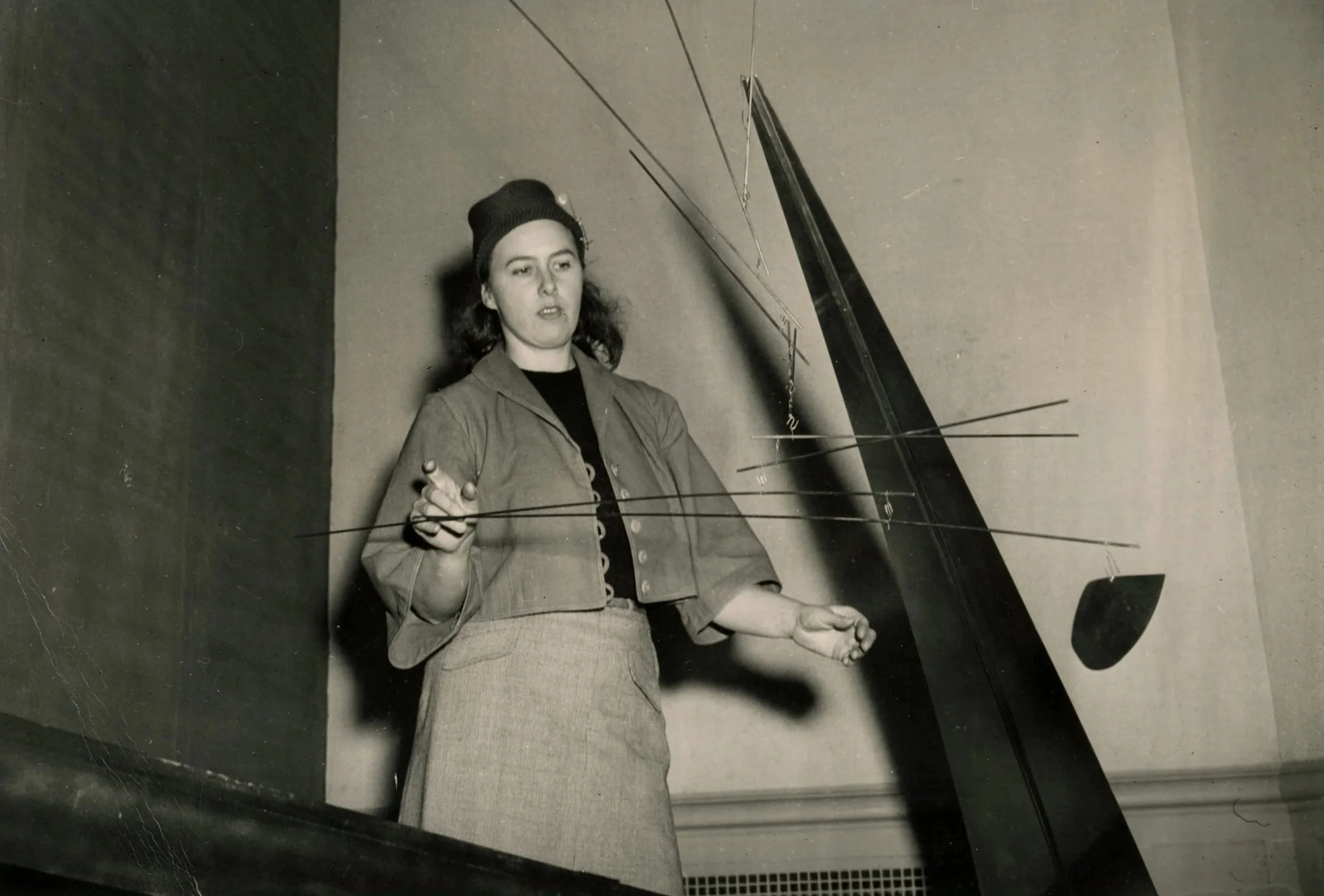
Claire Falkenstein with Water Reflector (1947) on view in Mobiles and Articulated Sculpture, California Palace of the Legion of Honor, San Francisco, California, 1948
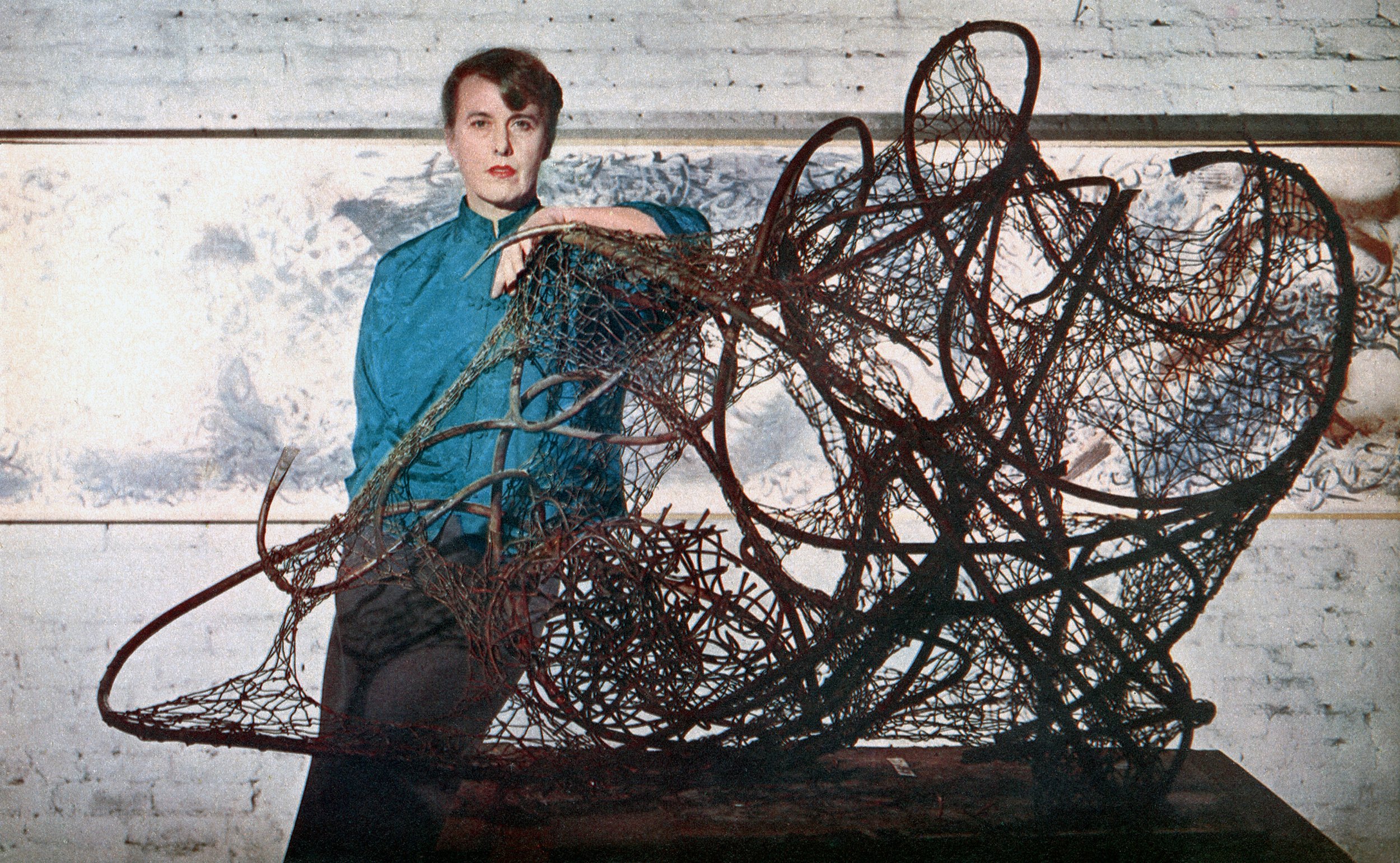
(Banner) Claire Falkenstein with the painting Glenburned (1959) in the background and sculpture Sun #14 (1958) in the foreground as reproduced in “Women of American Art” by Charlotte Williard in Look, vol. 24, no. 20 (September 27, 1960)
Oregon and the Bay Area: 1908–1949
Claire Falkenstein was born Claire von Falkenstein on July 22, 1908, in Coos Bay, Oregon, a small logging town on the state's rugged coastline. The youngest of three daughters, she later abandoned the use of “von” in her name and worked professionally as Claire Falkenstein. Her father managed a local sawmill, and the forests and timber industry that surrounded Coos Bay had a lasting influence on her life and artistic development. Depictions of sawmills and lumberjacks were recurring subjects in her early work, while carved wood remained an important material throughout her career.
In 1920, the von Falkenstein family relocated to the San Francisco Bay Area, settling in Oakland, where Claire attended Oakland High School and later the progressive all-girls Anna Head School in Berkeley. Falkenstein enrolled at the University of California, Berkeley, where she studied anthropology, philosophy, and art, and it was through the instruction of artist George Lusk that she first encountered European modernism. The Great Depression devastated the von Falkenstein family, forcing Falkenstein and her sisters to pursue independent lives; before graduating from Berkeley in 1930, Falkenstein secured a teaching position at Anna Head School. On July 14, 1934, she married Richard “Dick” McCarthy, a progressive labor attorney, whom she had met in high school.
Entering the new decade, Falkenstein established herself as an artist, exhibiting at local galleries and institutions including the California Palace of the Legion of Honor, the M. H. de Young Memorial Museum (now the de Young Memorial Museum), and the San Francisco Museum of Art (now the San Francisco Museum of Modern Art). In 1930, she mounted her first solo exhibition, a presentation of charcoal figure drawings at the East–West Gallery in San Francisco. In the summer of 1933, she studied briefly at Mills College with the European modernist Alexander Archipenko. These studies constituted her only formal training in sculpture.
Like many artists of her generation, Falkenstein found opportunities through the Works Progress Administration’s Federal Art Project (FAP). She produced a lyrical fresco of flowers, Poppy Abstraction (1934), for Piedmont High School in the East Bay, and documented life in the rural mining town of Virginia City, Nevada, through a series of drawings demonstrating emerging modernist sensibilities.
In the 1940s, Falkenstein was elected president of the San Francisco Society of Women Artists (SFSWA), and under her leadership, the organization launched volunteer workshops for war agencies and occupational therapy wards. She painted murals in support of the war effort, completing major commissions for hospitals, USO hospitality centers, and other military-sponsored buildings.
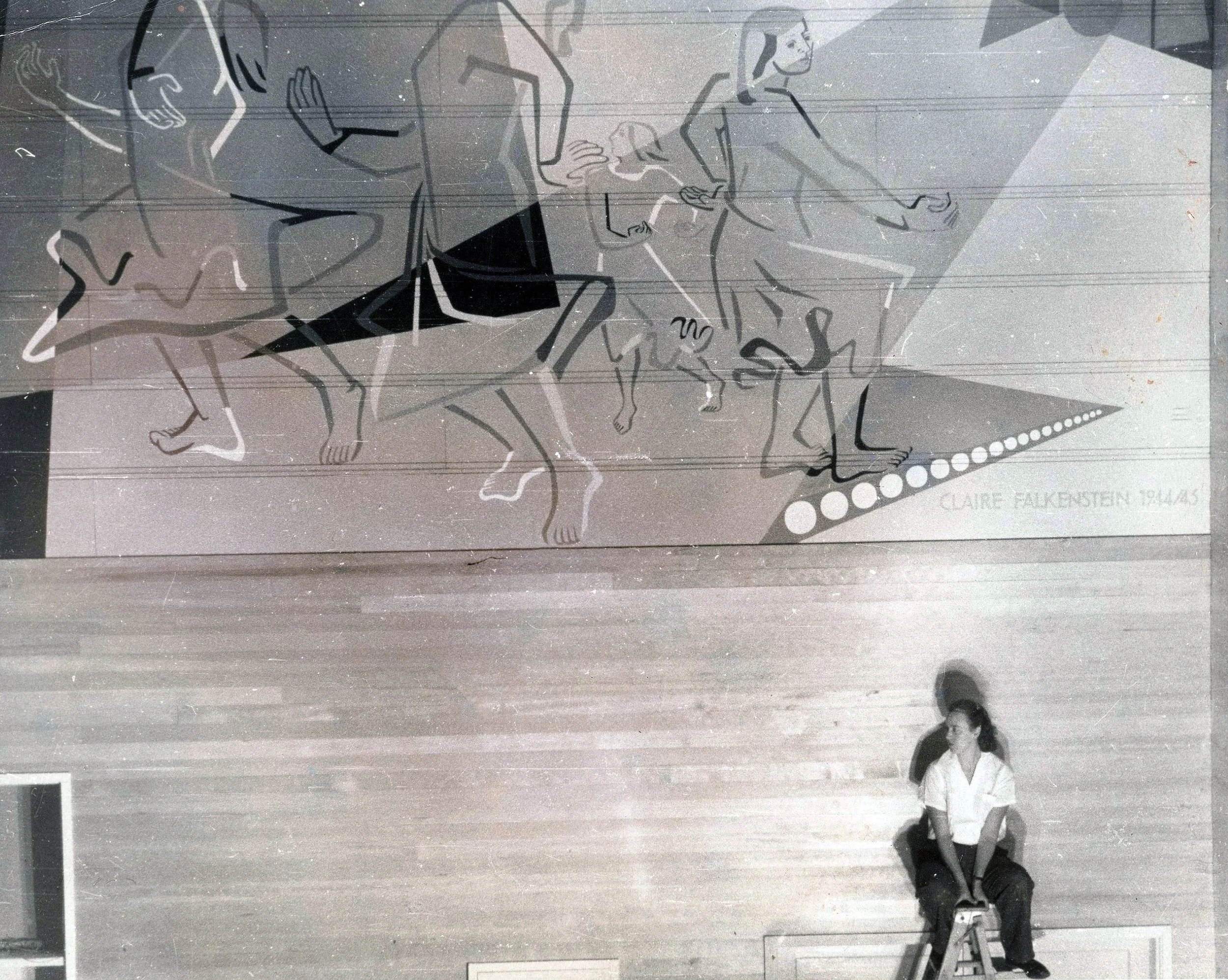
Claire Falkenstein with Expression, a detail of a mural in the theater at US Naval Hospital, San Leandro, California, 1944–45. Claire Falkenstein Papers, Archives of American Art, Smithsonian Institution
During this period, she produced ceramics, jewelry, paintings, prints, and sculptures in wood and wire. Carvings such as her polychrome Vigilante Victim (1940), made in response to the lynching of a Black man in Mississippi, demonstrate her fusion of abstract form and social commentary. Her series Set Structures (c. 1942–44) consists of bandsaw-cut, multi-part abstract forms intended to be taken apart and rearranged by the viewer. These works underscore Falkenstein’s interest in both the mathematical concept of sets and the potentially therapeutic effects of participatory sculpture for “nervous-handed people,” and they mark an early instance of what she described as an urge to “break up the volume”—to dismantle the traditional definition of sculpture as solid, self-contained mass.
Falkenstein became increasingly experimental in her approach to form and her interest in new media, prompted in part by the rationing of certain materials during the war. She painted biomorphic forms on both canvas and curved aluminum constructions; drew on X-ray film; designed wallpaper; and carved intricate forms into plexiglass to be illuminated by lightboxes. Spurred by the burgeoning interest in film in the Bay Area, Falkenstein shot Touching the Quick (1949), a portrait of curator Jermayne MacAgy’s exhibition Mobiles and Articulated Sculpture (1948) at the California Palace of the Legion of Honor.
In 1947, Falkenstein joined the faculty of the California School of Fine Arts (now the San Francisco Art Institute), then at the center of Bay Area artistic life, where she taught alongside Clyfford Still, who became a lifelong friend. In the summer of 1949, she taught at Pond Farm, the utopian craft community in Guerneville run by Bauhaus-trained potters Marguerite and Frans Wildenhain—her last significant undertaking before leaving for Europe.
By the late 1940s, Falkenstein had achieved many markers of career success in the tight-knit Bay Area arts community, yet she remained restless both artistically and personally. At the age of forty-two, she decided to move to Europe.
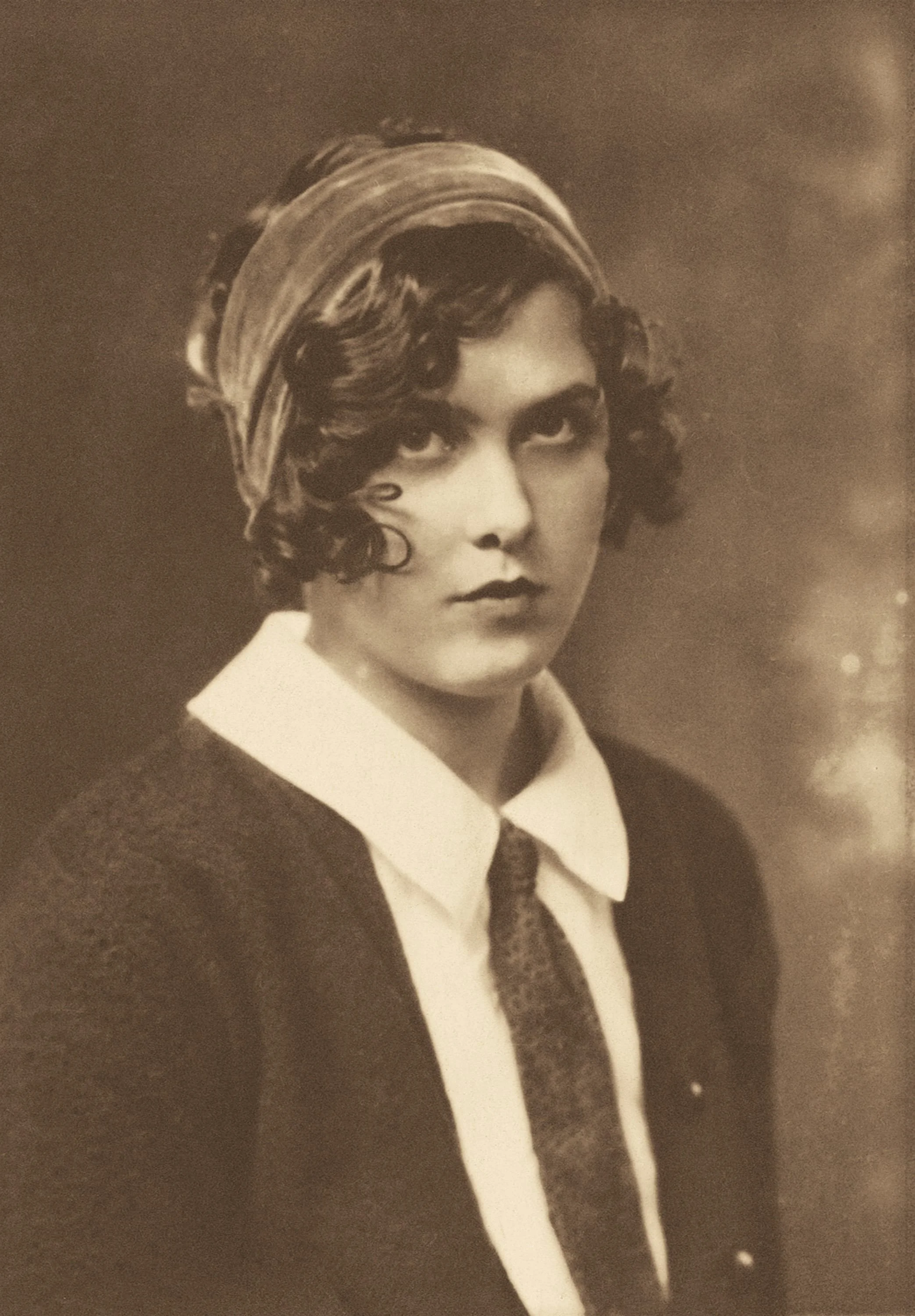
Claire Falkenstein yearbook photograph, Anna Head School, Oakland, California, 1926
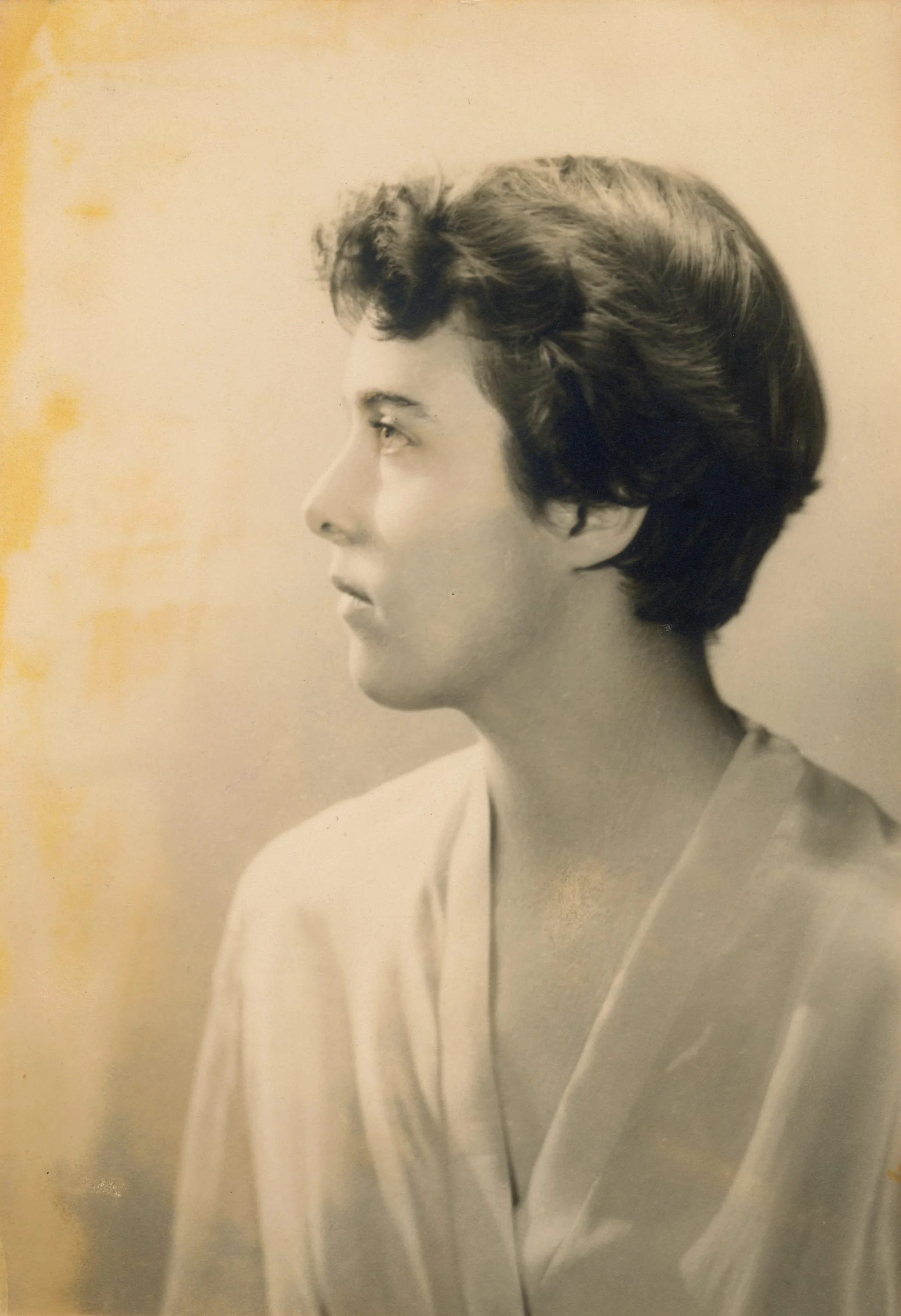
Claire Falkenstein, c. 1930s
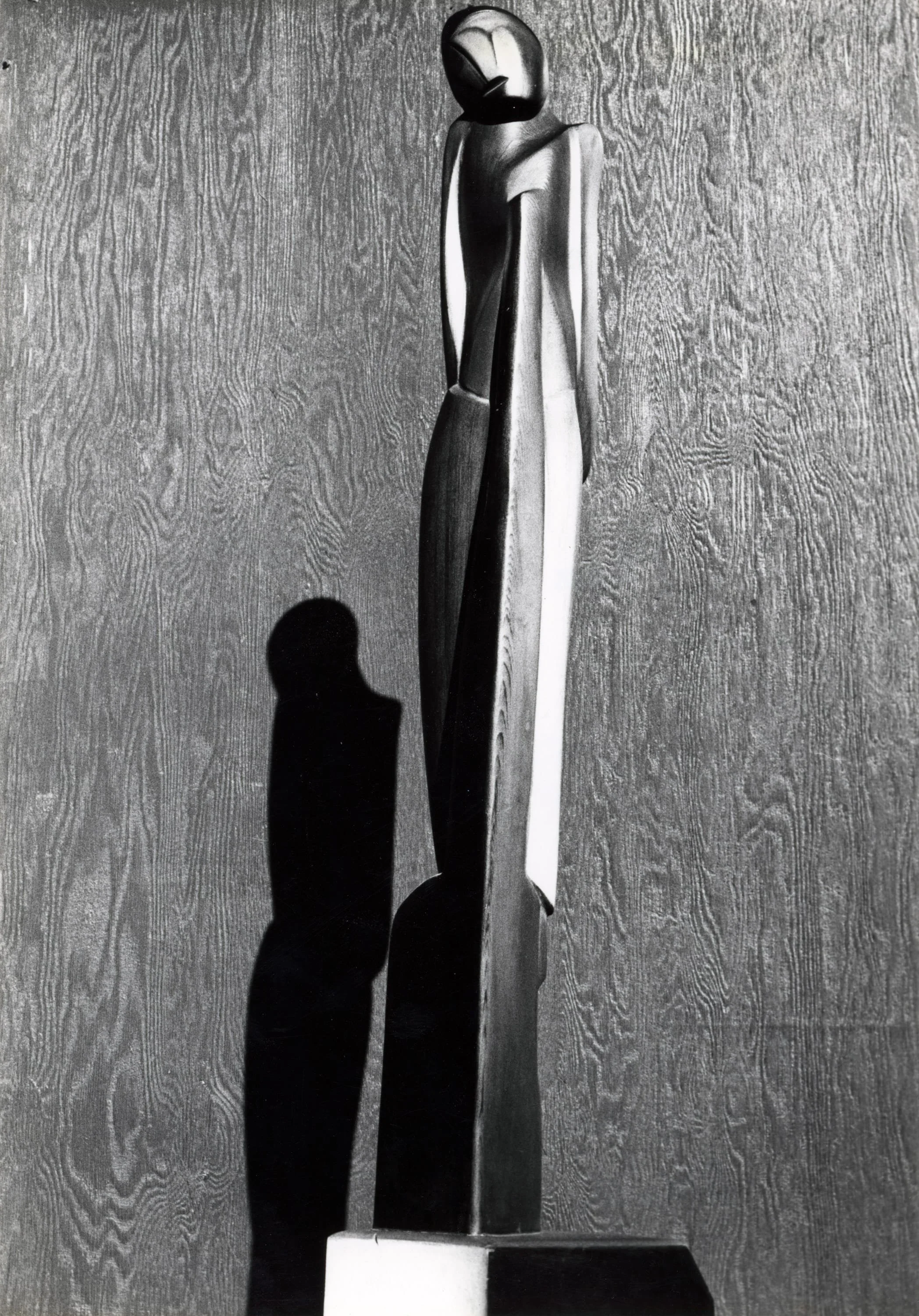
Claire Falkenstein, Vigilante Victim #1, 1940. Collection of Lani Martin on extended loan to the Oakland Museum of California
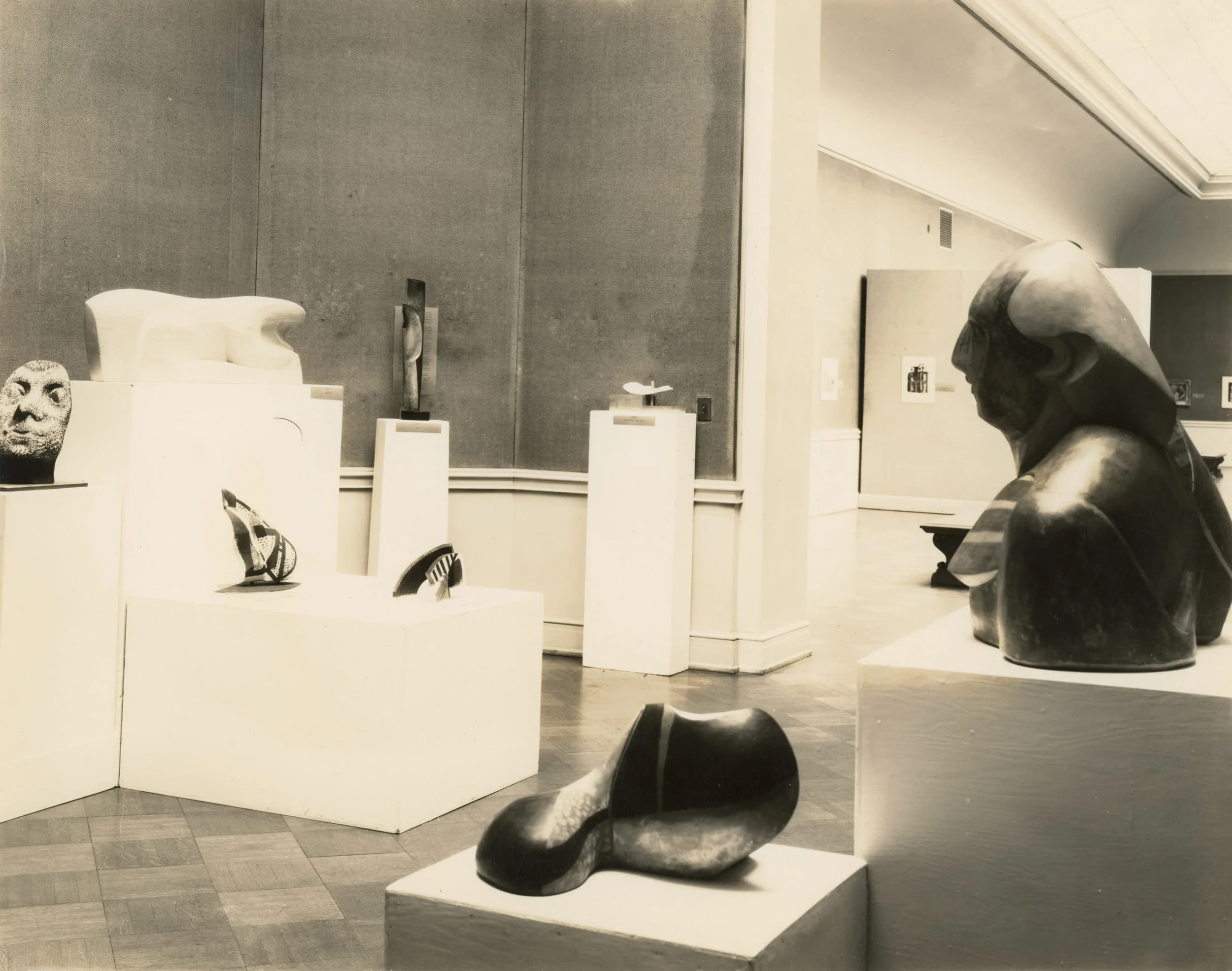
Installation view of Paintings and Sculpture by Claire Falkenstein, San Francisco Museum of Art, California, 1941
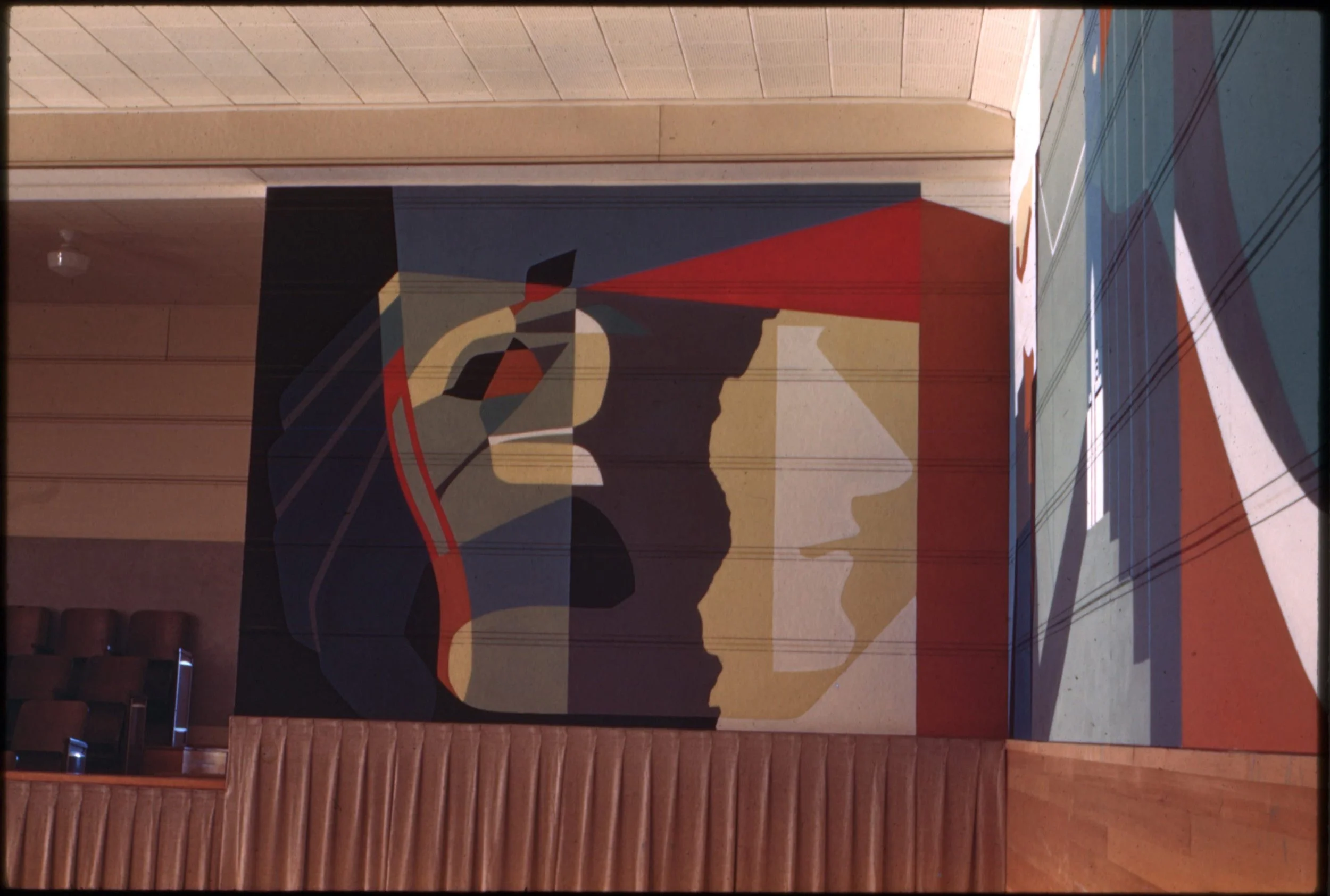
Claire Falkenstein, Human Sensibilities, detail of a mural in the theater at US Naval Hospital, San Leandro, California, 1944–45. Slide from the collection of Lani Martin
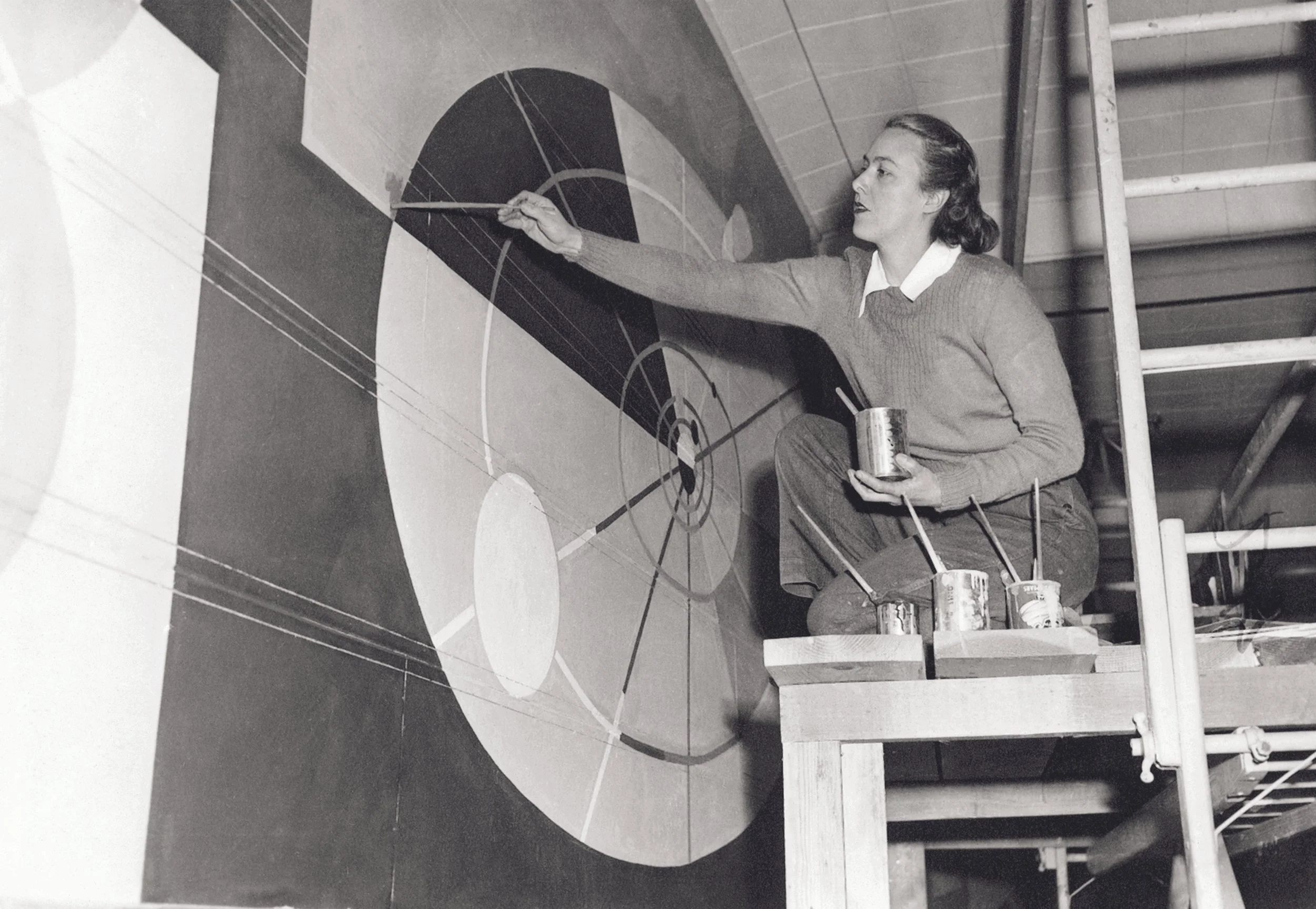
Claire Falkenstein working on Growth, a mural for the south wall of the theater at U.S. Naval Hospital, San Leandro, California, c. 1945. Claire Falkenstein Papers, Archives of American Art, Smithsonian Institution
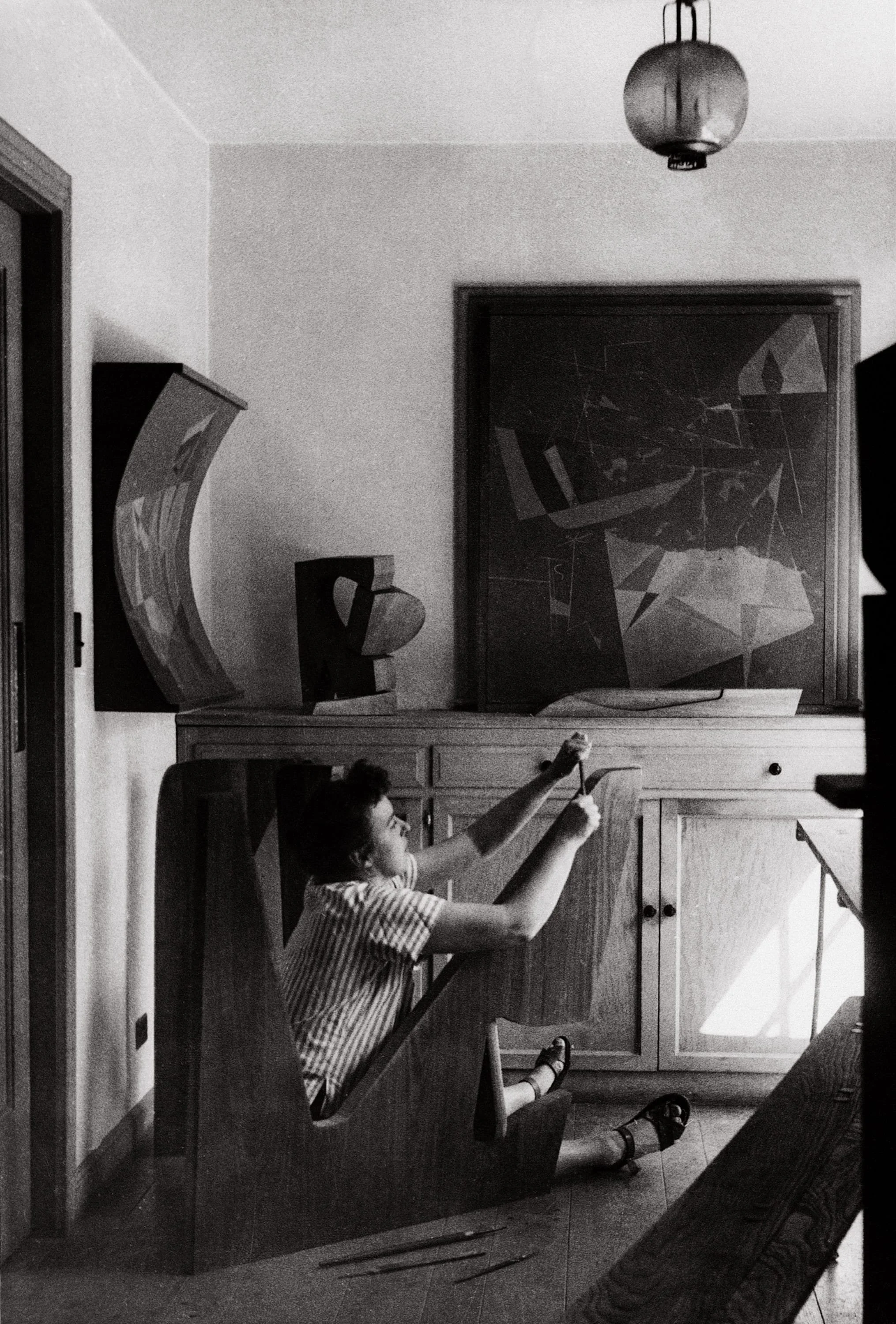
Falkenstein constructing a table for Joseph Bransten in her home studio, Berkeley, California, 1948
Paris and Italy: 1950–1962
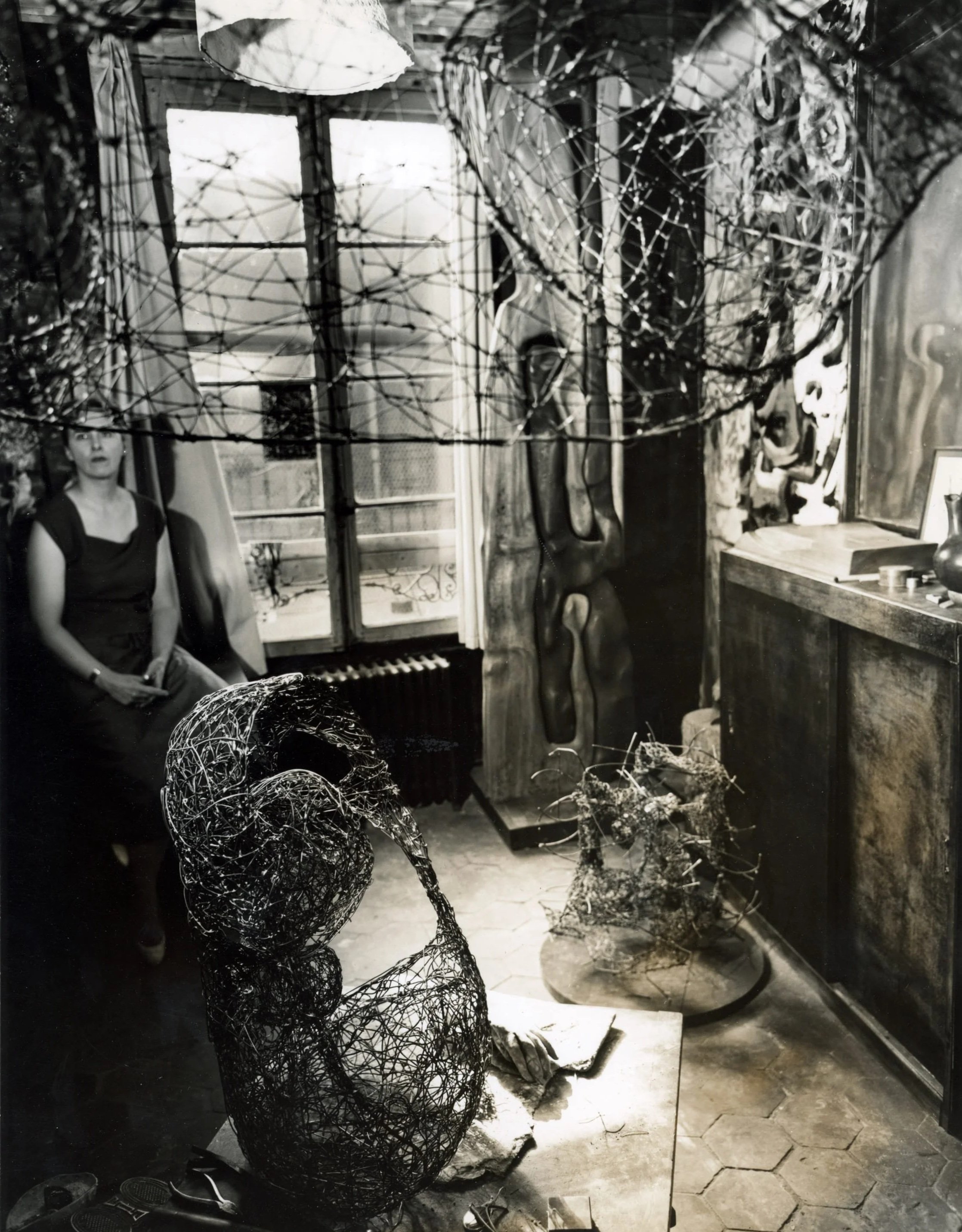
Falkenstein in her studio at 13 Rue de Savoie, Paris, France, c. 1956
In the summer of 1950, Falkenstein embarked on a month-long tour through Western Europe that concluded in Paris. Delaying her return indefinitely, she remained in Paris, connecting with artists including American expatriates Sam Francis and Frank Lobdell, as well as avant-garde luminaries such as Alberto Giacometti, Jean Arp, and Constantin Brâncuși. She eventually established a studio at 13 rue de Savoie, just blocks from the Seine, where she began experimenting with structures made of inexpensive stovepipe wire, which would become central to her work.
Falkenstein’s wire sculptures caught the attention of French critic and curator Michel Tapié de Céleyran, a champion of emerging artists in France, Italy, and Spain. At the time, Tapié was developing what he would term art autre, translated into English as “other art” or “art of another kind.” Most visible in painting, art autre privileged abstract and gestural approaches aligned with movements such as Art Informel, the School of Paris, and American Abstract Expressionism. Falkenstein embraced Tapié’s concept of art autre, identifying in it a rupture with the past and a new understanding of space that she was attempting to capture in her sculptures. Tapié would become her most influential advocate in Europe.
In 1954, Falkenstein created the first sculpture in her Suns series: dense, lattice-like structures of twisted metal with visible brazing that evoke a dynamic relationship between interior and exterior space. Although the title of this series, along with a smaller body of work titled Moons, invokes the celestial, these sculptures do not rely on visual resemblance to planetary bodies—indeed, they are rarely spherical. Rather, these works seek to convey the energy, scale, and power of cosmic phenomena. Falkenstein exhibited her Suns suspended from wires and set on pedestals, and she increasingly incorporated colored glass into their construction. The Suns reflect Falkenstein’s engagement with evolving conceptions of space, time, physics, the universe, and human perception, all of which were being radically transformed in the postwar period by the widespread acceptance of Einstein’s theory of relativity, the implications of nuclear fission, and the exploration of space.
Through Michel Tapié and his greater network, Falkenstein began working on architectural commissions, starting with a sculptural stair rail for architect Luigi Moretti’s Galleria Spazio in Rome in 1954. At Moretti’s request, she incorporated colored glass into the staircase through a process she devised for fusing metal and glass in a kiln to prevent the glass from shattering. She would later apply this technique to her Suns. This commission was followed by another stair rail for Galerie Stadler in Paris in 1955, a new venture founded by gallerist Rodolphe Stadler and Tapié
Falkenstein was increasingly living between Paris and Italy, particularly Milan, Rome, and Venice. In 1957, Moretti invited Falkenstein to create a set of gates for the beachside grotto of Villa La Saracena, outside Rome, which he designed for Princess Luciana Malgeri Pignatelli. Falkenstein made her Pignatelli Gates from forged and strapped steel, heated over an open coal fire on the beach. She hammered each piece on an anvil and integrated large chunks of Murano glass, which she pressure-set into the forms.
In 1958, the modern dancer and Falkenstein's lifelong friend May O'Donnell commissioned a sculpture to share the stage with her dancers. Falkenstein, recovering from a fall and confined to bed, could not bend iron wire to the scale the piece demanded. She turned to copper tubing, which she could shape by hand even in her constrained setup. The workaround to make Suspension proved foundational: copper tubing became a defining material of her later work and, because water could run through it, the very thing that made her large-scale fountains possible.
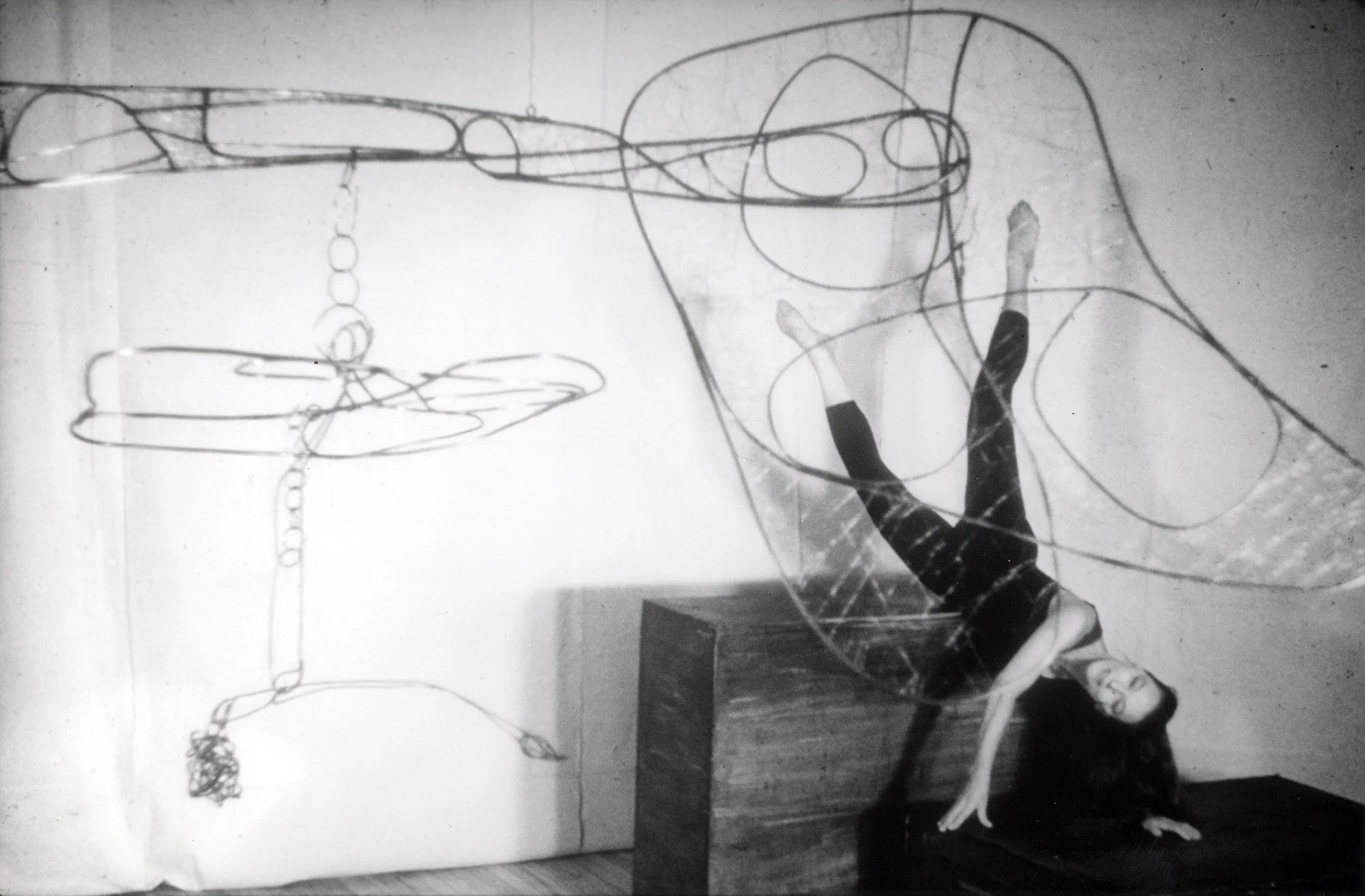
May O'Donnell performing with Claire Falkenstein's Suspension, Hunter Playhouse, New York City, 1958
A visit to Peggy Guggenheim’s palazzo in Venice in 1960 sparked a commission for another set of gates. For the Guggenheim gates, Falkenstein adapted the visual language of her Never-Ending Screens, welded panels of angled metal rods whose open networks imply an extension, theoretically, to infinity. Like the Pignatelli Gates, the Guggenheim gates incorporated large pieces of colored glass, pressure-set into the structure. Guggenheim referred to the resulting work as her “Gates of Paradise,” and they remain the entranceway to the Peggy Guggenheim Collection.
While Falkenstein’s years in Europe marked a remarkable development in her sculptural practice, she also experimented with two-dimensional processes. Early in her time in Paris, she began producing experimental prints at the celebrated workshop Atelier 17 by running small, rough metal sculptures through a printing press to create deep impressions in wet paper. Well received, these Object Gravures anticipated her Struttura grafica portfolio, realized at Milan’s Grafica Uno in 1962.
In 1959, she devised a visual language of small, repetitive pen-and-brush marks that formed intricate compositions she would come to call her Moving Point series. She later adapted the Moving Point motif into paintings, drawings, and a select number of sculptures, describing this practice as “a very rigorous kind of discipline.” Explaining her process, she remarked: “Each time you make the point, it’s a new start. And then it matures as you cover the surface.”
While her period in Europe was artistically exhilarating, Falkenstein also lived with meager resources and contended with personal challenges. Although her husband Richard McCarthy remained a lifeline throughout her years abroad and a lifelong friend, the two amicably divorced in 1957. Once again seeking new opportunities and a context in which to grow her practice, Falkenstein was drawn back to California in the 1960s.
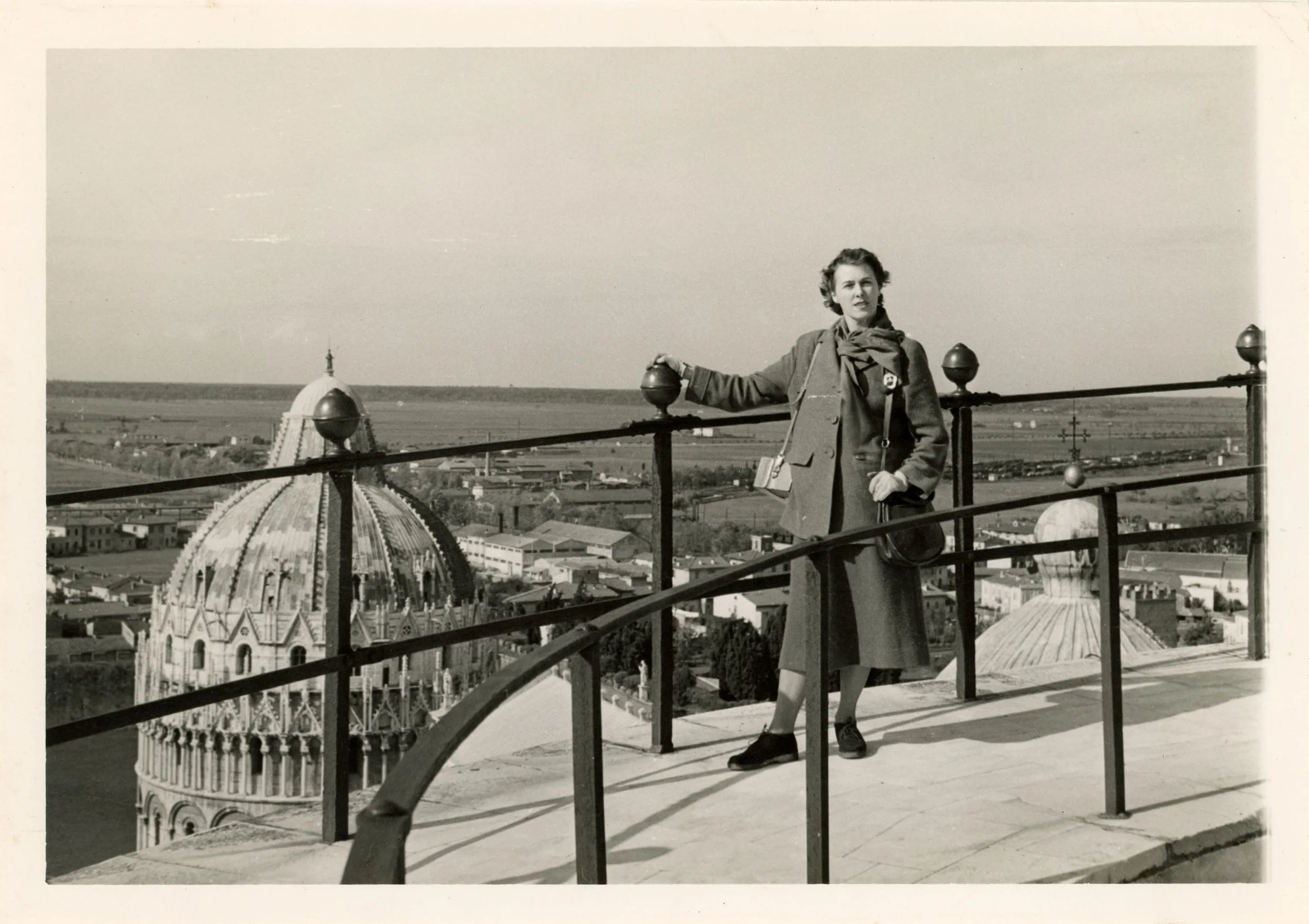
Claire Falkenstein on top of the Tower of Pisa, Italy, 1950
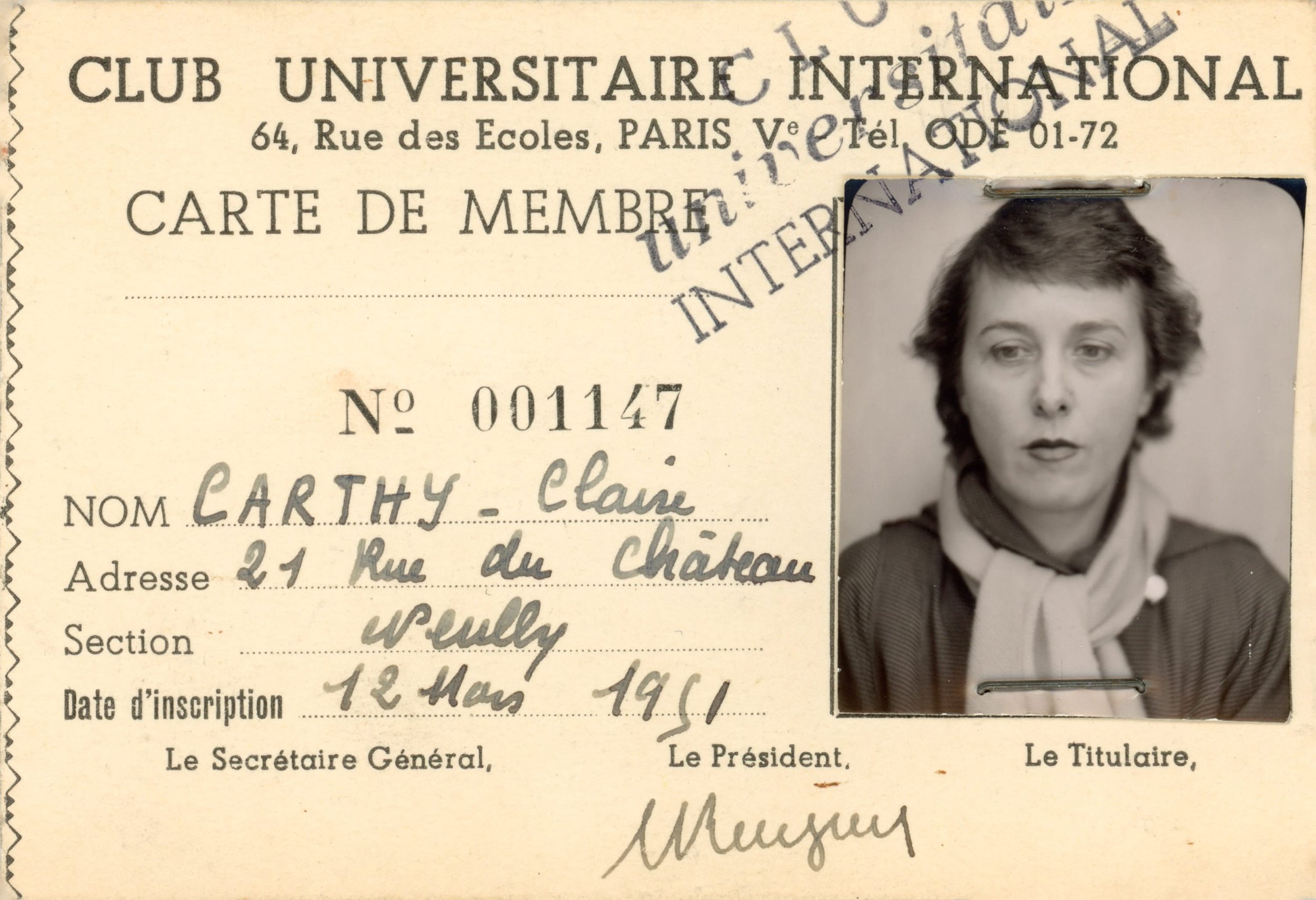
Claire Falkenstein's membership card for the Club Universitaire International (CUI), Paris, France, 1961
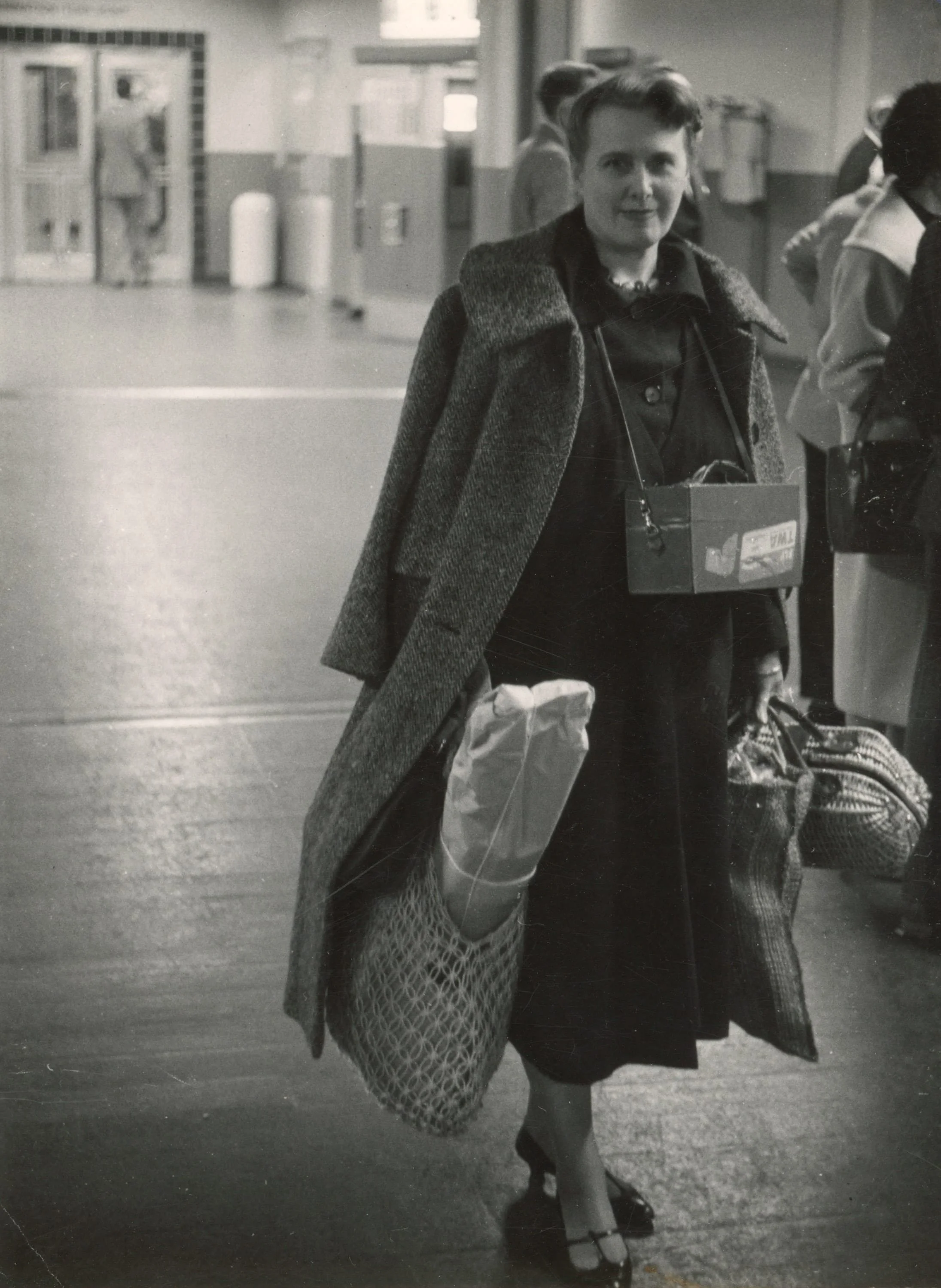
Claire Falkenstein at a train station, possibly Rome, Italy, c. 1954
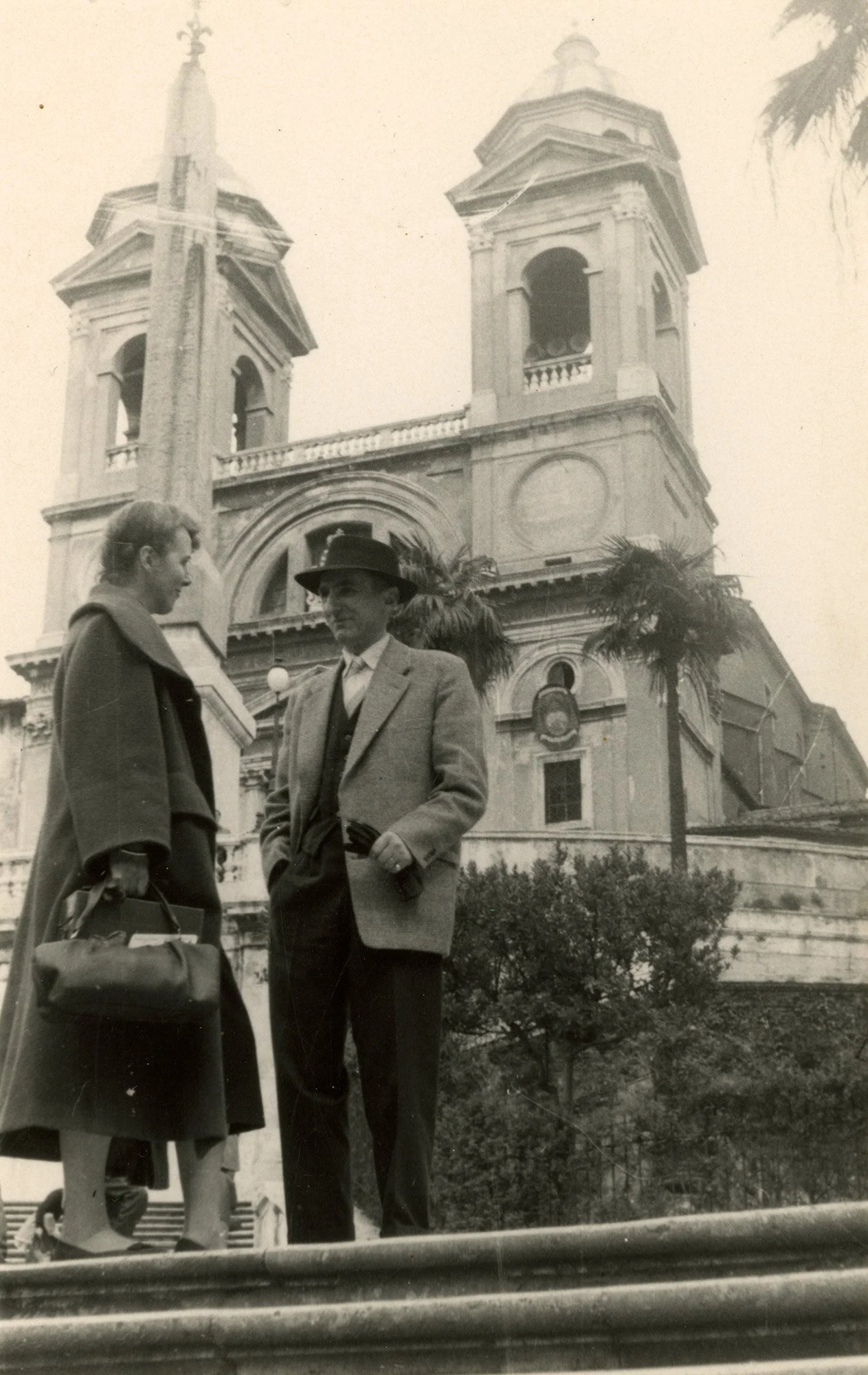
Claire Falkenstein and Michel Tapié at the Spanish Steps in Rome, Italy, 1954
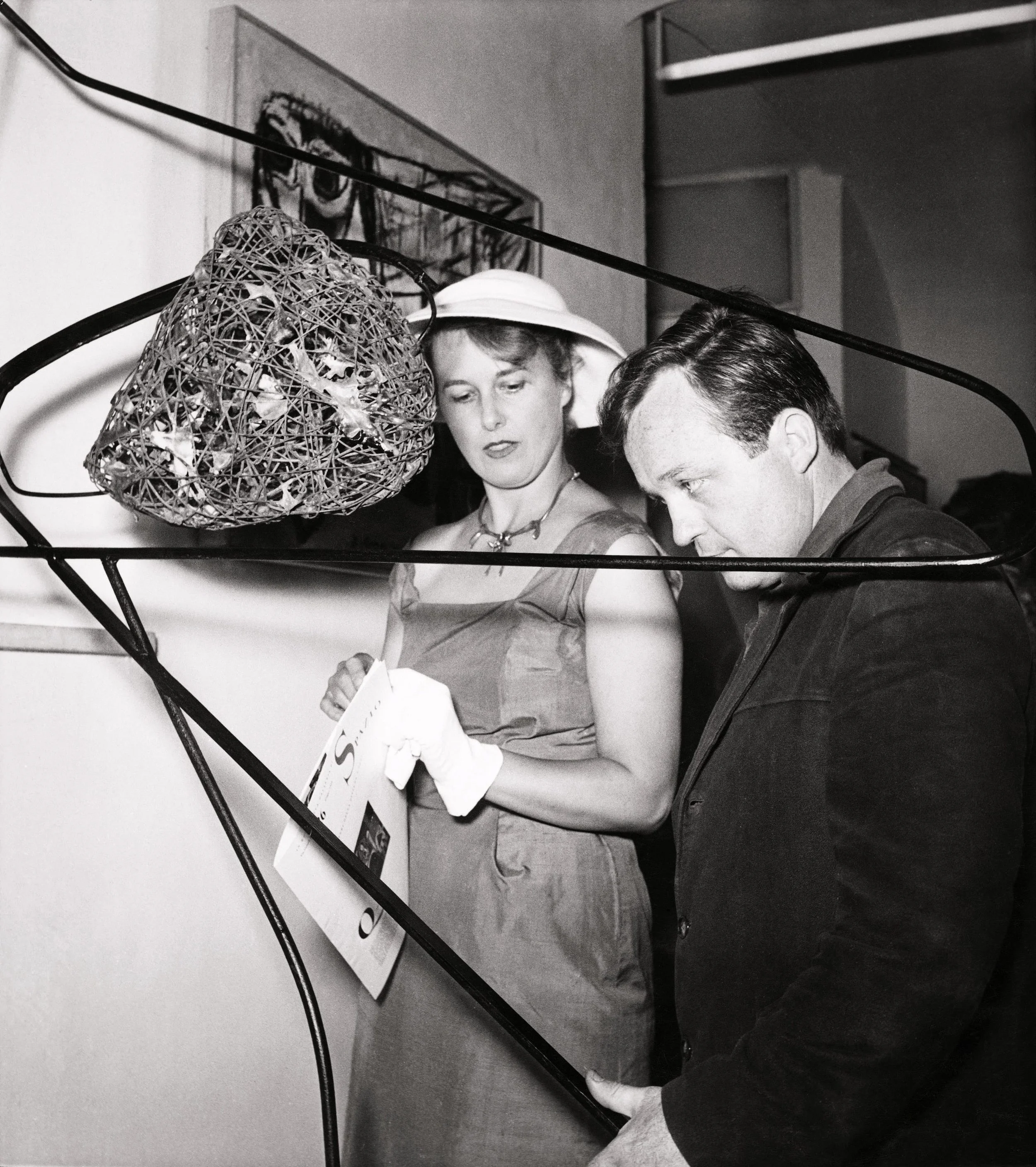
Claire Falkenstein and Sam Francis with Falkenstein's Stair Screen at Galleria Spazio, Rome, Italy, 1954
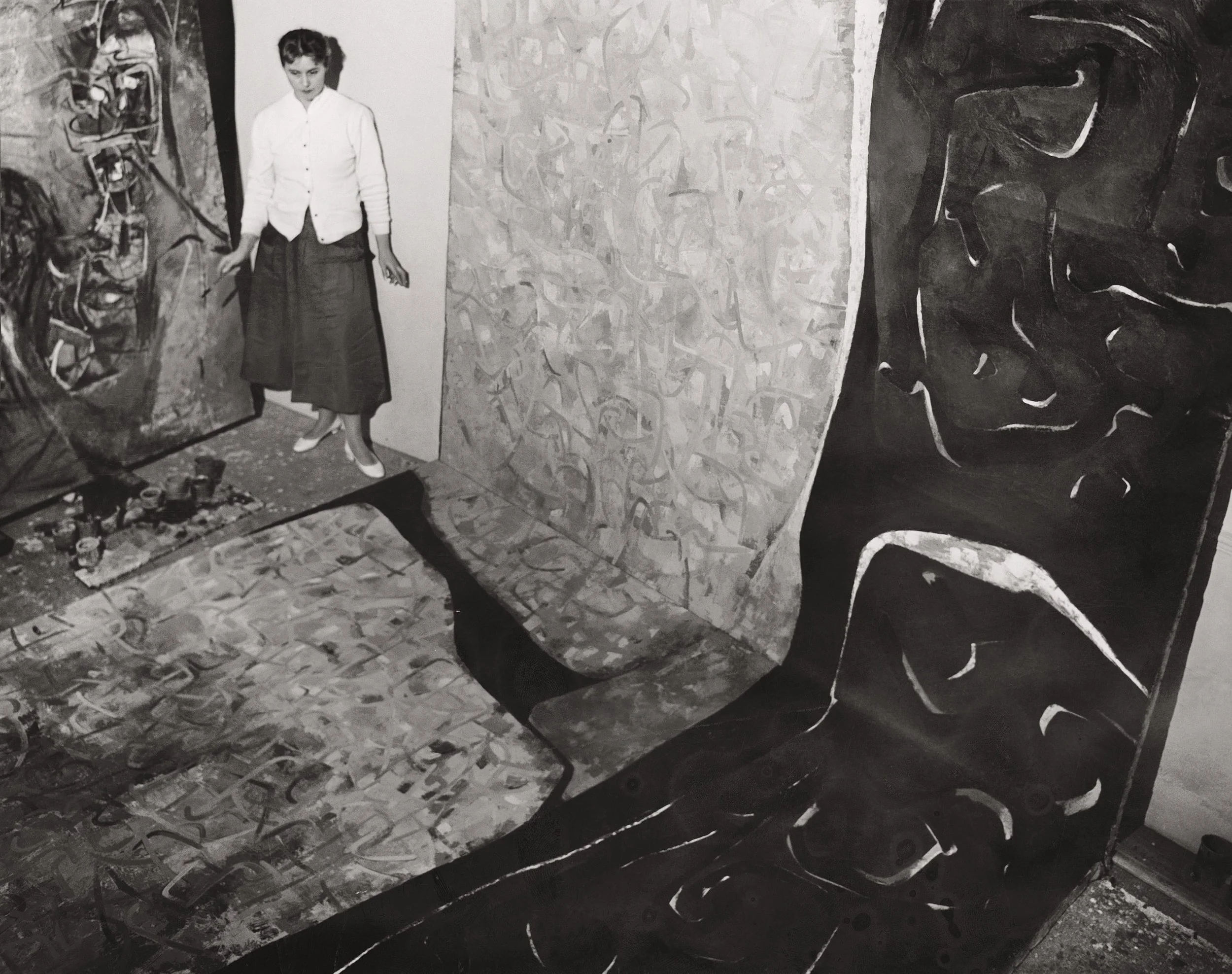
Claire Falkenstein with Mural (Coast to Coast) for the Donal and Helen Olsen House, outside of her studio in Paris, France, 1956
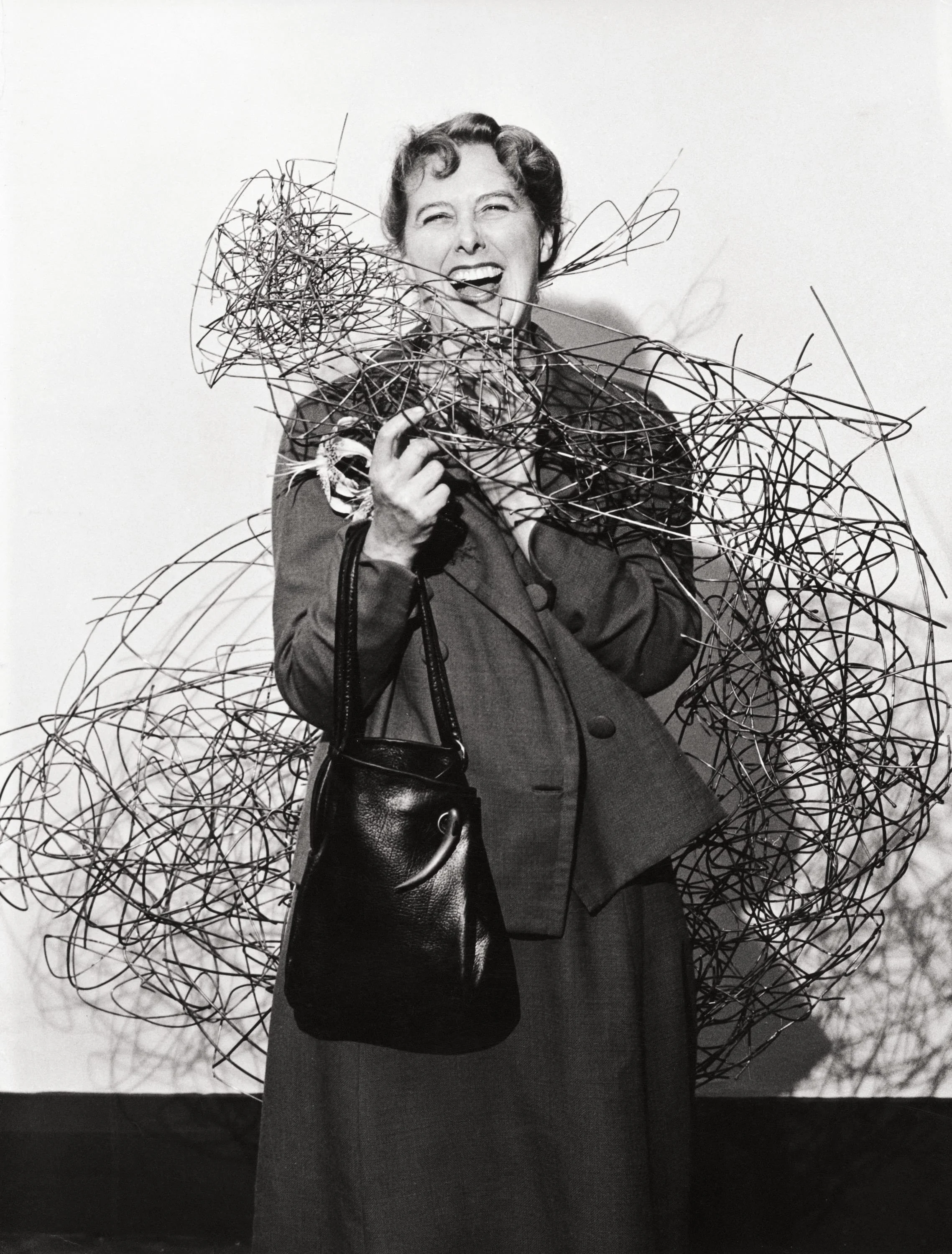
Claire Falkenstein surrounded by Sun #11 at Galerie Stadler, Paris, France, 1957. Claire Falkenstein Papers, Archives of American Art, Smithsonian Institution
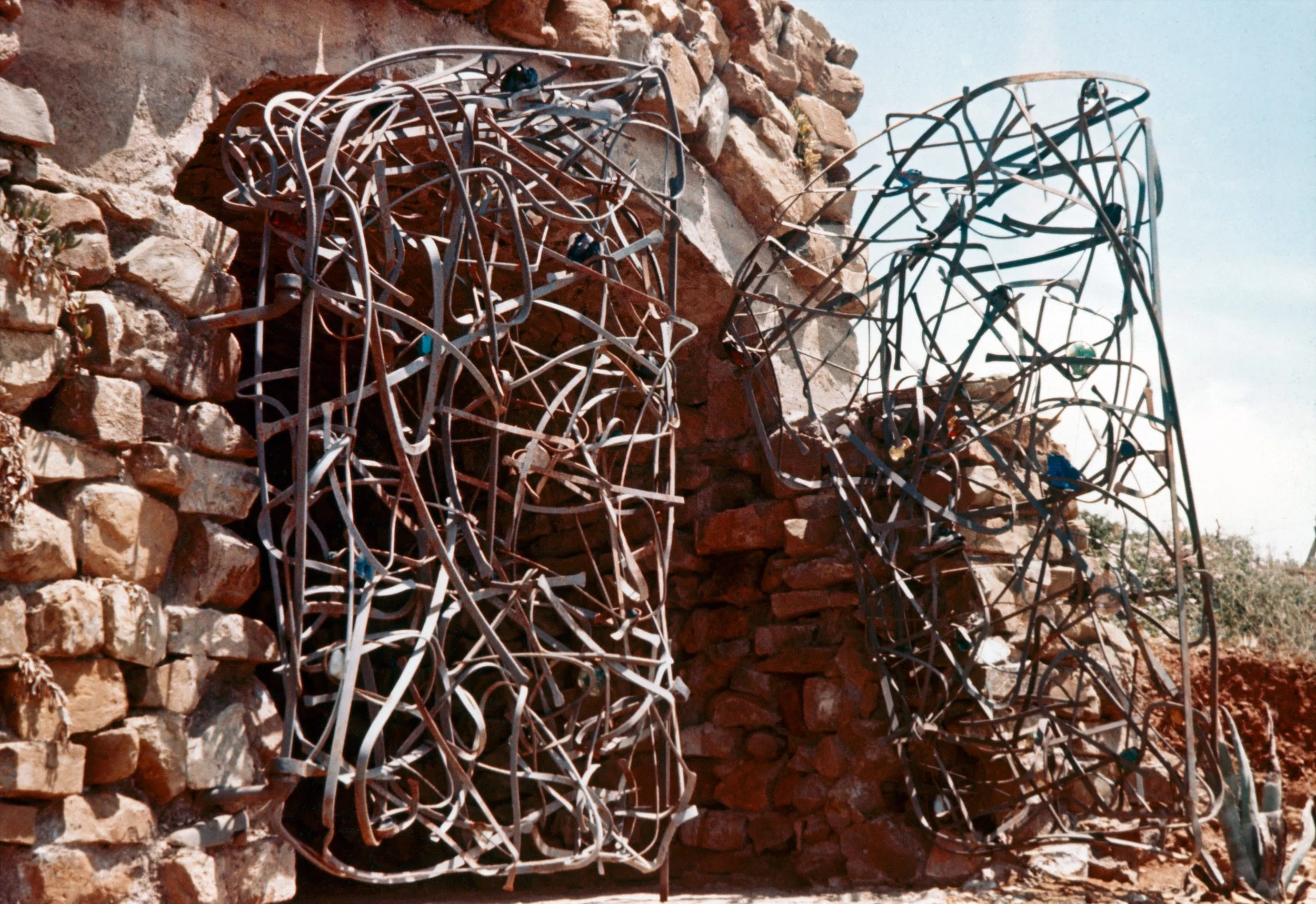
Claire Falkenstein, Pignatelli Gates at Villa La Saracena, Santa Marinella, Italy, 1957
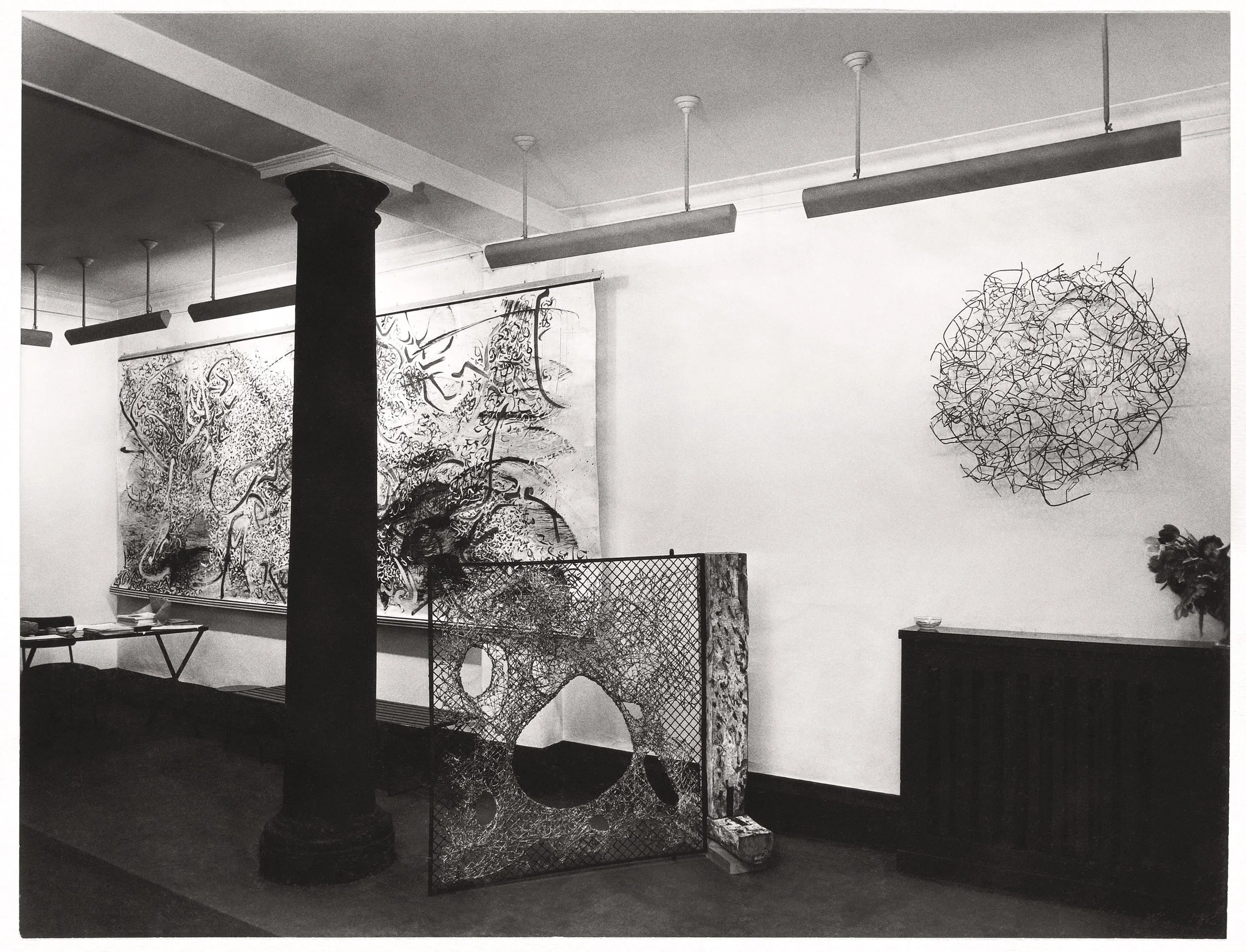
Claire Falkenstein's work at Galerie Stadler, Paris, France, 1960
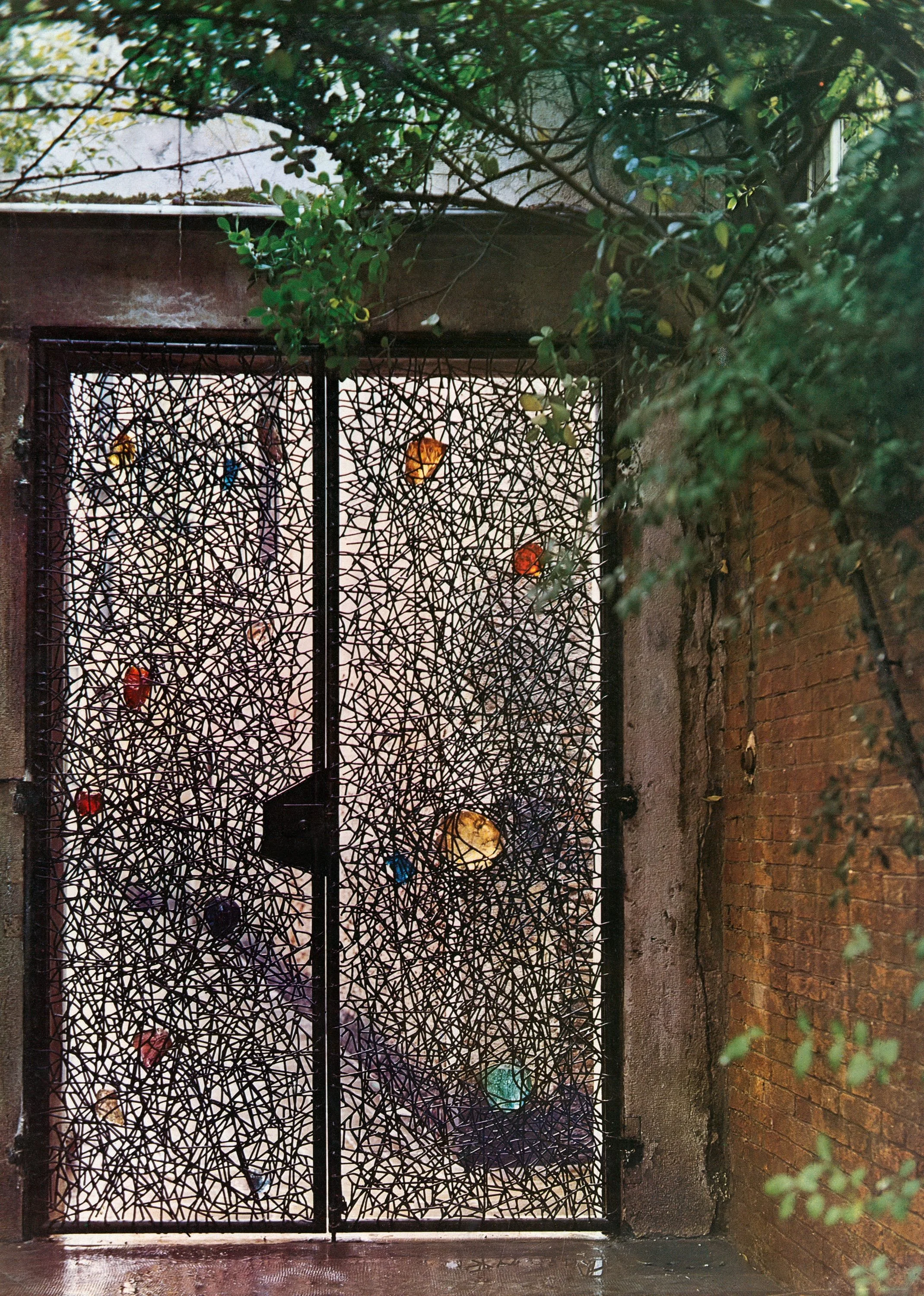
Claire Falkenstein, Entrance Gates to the Palazzo, Palazzo Venier dei Leoni, Peggy Guggenheim Collection, Venice, Italy, 1961
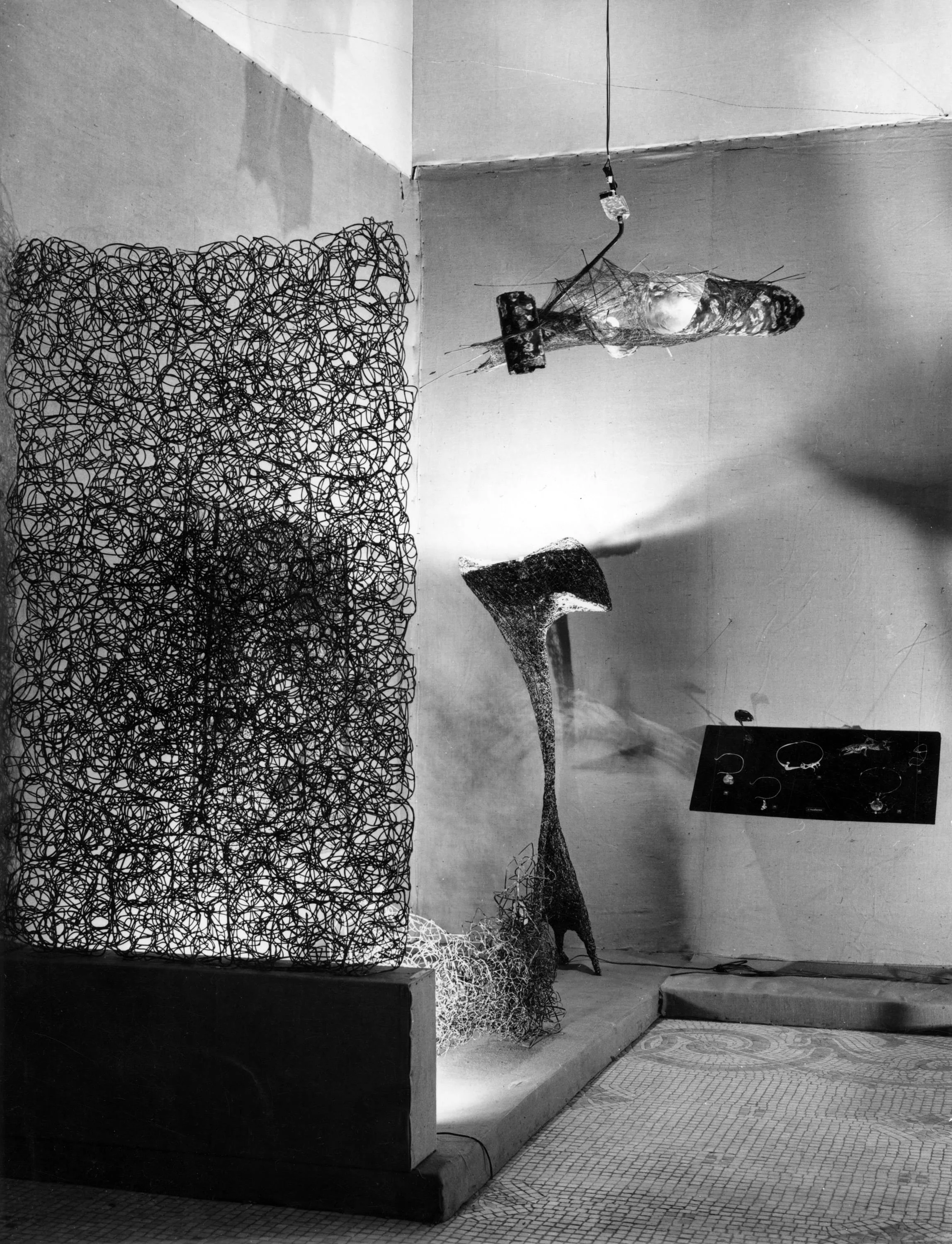
Claire Falkenstein's work in the exhibition Antagonismes 2: L’Objet, Musée des Arts Décoratifs, Palais du Louvre-Pavillion de Marsan, Paris, France, 1962. Photo from the collection of Lani Martin
Los Angeles: 1963–1997
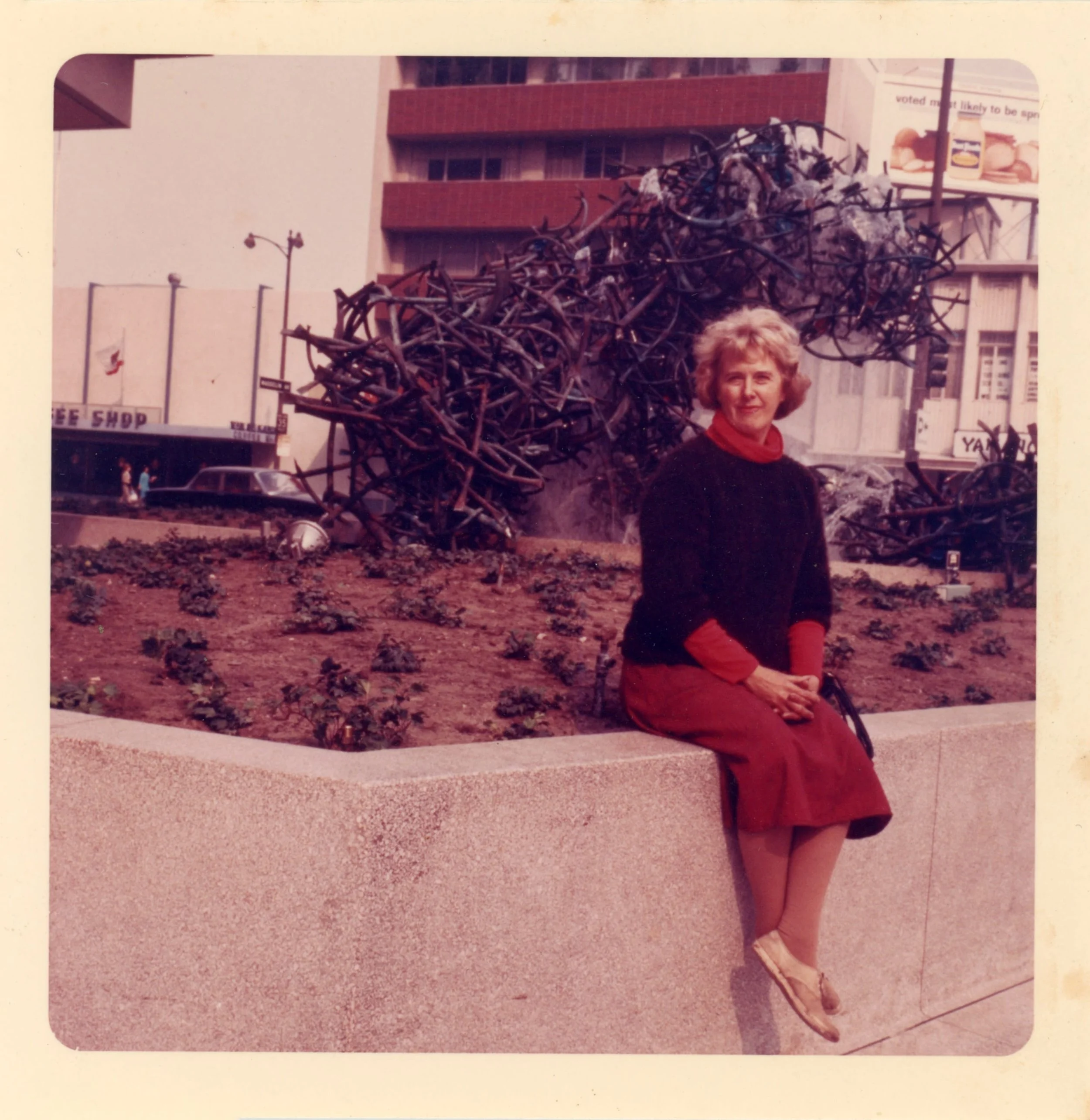
Claire Falkenstein in front of Structure and Flow #2, California Federal Savings & Loan Association Building, Los Angeles, California, 1965
Throughout her time in Europe, Falkenstein maintained strong personal and professional connections in California. By the early 1960s, a growing cluster of commissions—and the welcoming network of patrons behind them—pulled her decisively toward Los Angeles.
In 1963, Falkenstein’s gallerist, Esther Robles, commissioned her to create a large-scale outdoor fountain for her home in the Brentwood neighborhood of Los Angeles. Originally titled Linear Fountain #1 (later retitled Structure and Flow #1, 1963–64), the work was built from twisting, interconnected copper tubing punctuated with sections of melted, colored glass, with water flowing out through multiple openings across the structure. It marked an early articulation of the contradictory principle that would come to define her sculpture—what she called “structure and flow,” a continuity bound up with discontinuity—and gave the resulting series its name.
Through the recommendation of Richard Brown, then director of the Los Angeles County Museum of Art, Falkenstein received another fountain commission for the new California Federal Savings & Loan Association Building on Wilshire Boulevard in Los Angeles’s Miracle Mile district. Structure and Flow #2 (1965) was a monumental sculpture made from copper tubing embedded with chunks of colored glass. To realize the project, Falkenstein purchased a property at 719 Ocean Front on the Venice boardwalk, which would become her home and studio for the rest of her life. She had a large basin constructed on the property, in which she could assemble the work in a space comparable to its intended site. The resulting fountain measured fourteen feet high, forty-five feet long, and thirty feet wide. Its wave-like network of interconnected copper tubing channeled and released flowing water. The fountain sparked controversy almost immediately after its installation, drawing widespread national media attention; the Los Angeles Times jokingly dubbed it “Falkenstein Falls.” Plagued by mismanagement and inadequate maintenance, the fountain fell into disrepair. It was ultimately dismantled in 1989 and destroyed by vandals the following year.
Into the late 1960s, Falkenstein worked tirelessly designing the monumental windows and doors for St. Basil Catholic Church in what is now the Koreatown neighborhood of Los Angeles. The largest commission of her career, the artist devised fifteen towering windows of Cor-Ten steel and colored glass positioned between piers of poured concrete. The arrangement of each section, as well as the kaleidoscopic combination of fifteen stained-glass colors, was meticulously devised using intricate models. The windows and doors extended the visual language of her Never-Ending Screen into architecture, translating her exploration of infinity into a sacred space.
Throughout the 1960s, Falkenstein also continued her exploration of the Moving Point through painting and drawing. Her nearly twenty-foot-wide painting on nine panels, Orbit the Earth (1963), employs shimmering silver, gold, and copper metallic paints. Created in response to John Glenn’s landmark orbital journey the previous year, the work demonstrates Falkenstein’s enduring fascination with the cosmos during the height of the Space Race. She also began naming her Moving Point paintings after locations and thoroughfares in and around her adopted home of Los Angeles, including Figueroa, La Brea, and Topanga.
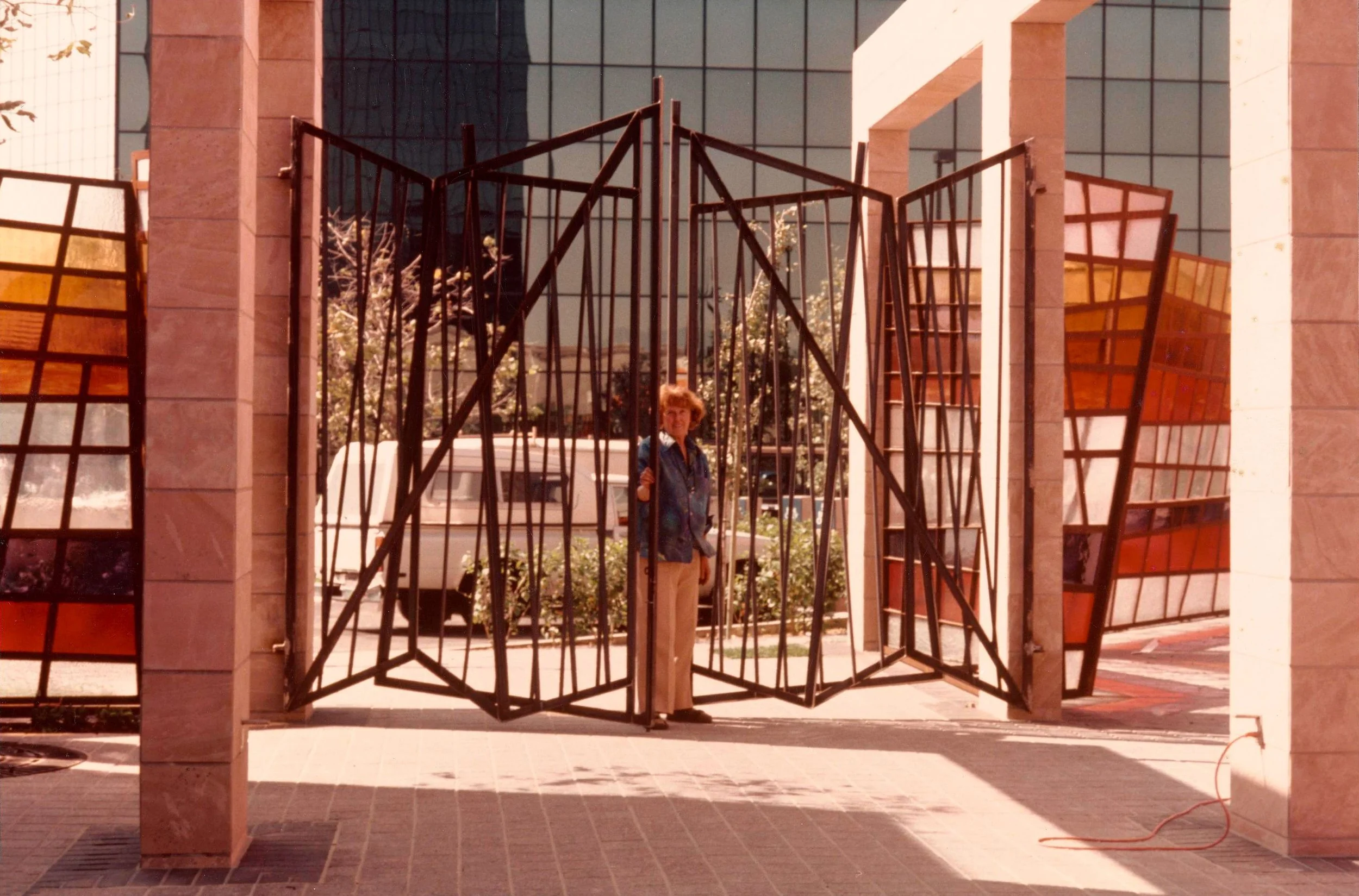
Claire Falkenstein at the gates for Sun Ribbon, Pacific Arts Plaza (formerly South Coast Plaza Town Center), 1982. Claire Falkenstein Papers, Archives of American Art, Smithsonian Institution
Into the 1970s, Falkenstein continued to realize significant public commissions. DNA Molecule (c. 1970–71), created for Hyland Laboratories for the Investigation of Blood in Costa Mesa, California, was a kinetic sculpture made of copper and glass. The work features two nested structures that rotate in opposite directions, evoking the movement of DNA’s double-helix strands when activated. Montage/Section (1976), created for the lobby of the Eileen Norris Cinema Theatre at the University of Southern California, drew inspiration from unspooled film, translating the sequential and rhythmic qualities of cinema into sculptural form. In the following decade, she realized Sun Ribbon (1980)—a wall of colored glass originally positioned between stone columns—as a gateway to Isamu Noguchi’s California Scenario near South Coast Plaza in Costa Mesa. Dedicated in 1987, The Forum was a “socio-sculptural environment” at California State University, Dominguez Hills constructed from cedar logs sourced in Port Orford, Oregon.
Throughout the 1960s and 1970s, Falkenstein continually worked with copper and melted glass, creating works of varying scales through her Fusions series that combined sensual forms with dynamic, often contradictory tensions. In the late 1970s, she also produced a series of sculptures utilizing raw wood, bamboo, canvas, and copper, described by New York magazine critic John Ashbery as “three-dimensional drawings.” In her later years, Falkenstein returned to painting, producing works that translated the dynamic motion of her Moving Point series into similarly symbolic abstract patterns, as well as playful figurations of wrestlers, acrobats, and galloping horses.
Falkenstein died on October 23, 1997, at her home in Venice after a battle with cancer. In accordance with the artist’s wishes, the Claire Falkenstein Foundation was established to preserve and promote her legacy.
Special thanks to scholar and curator Marin R. Sullivan, whose forthcoming biography of Claire Falkenstein was an invaluable resource in writing this text.
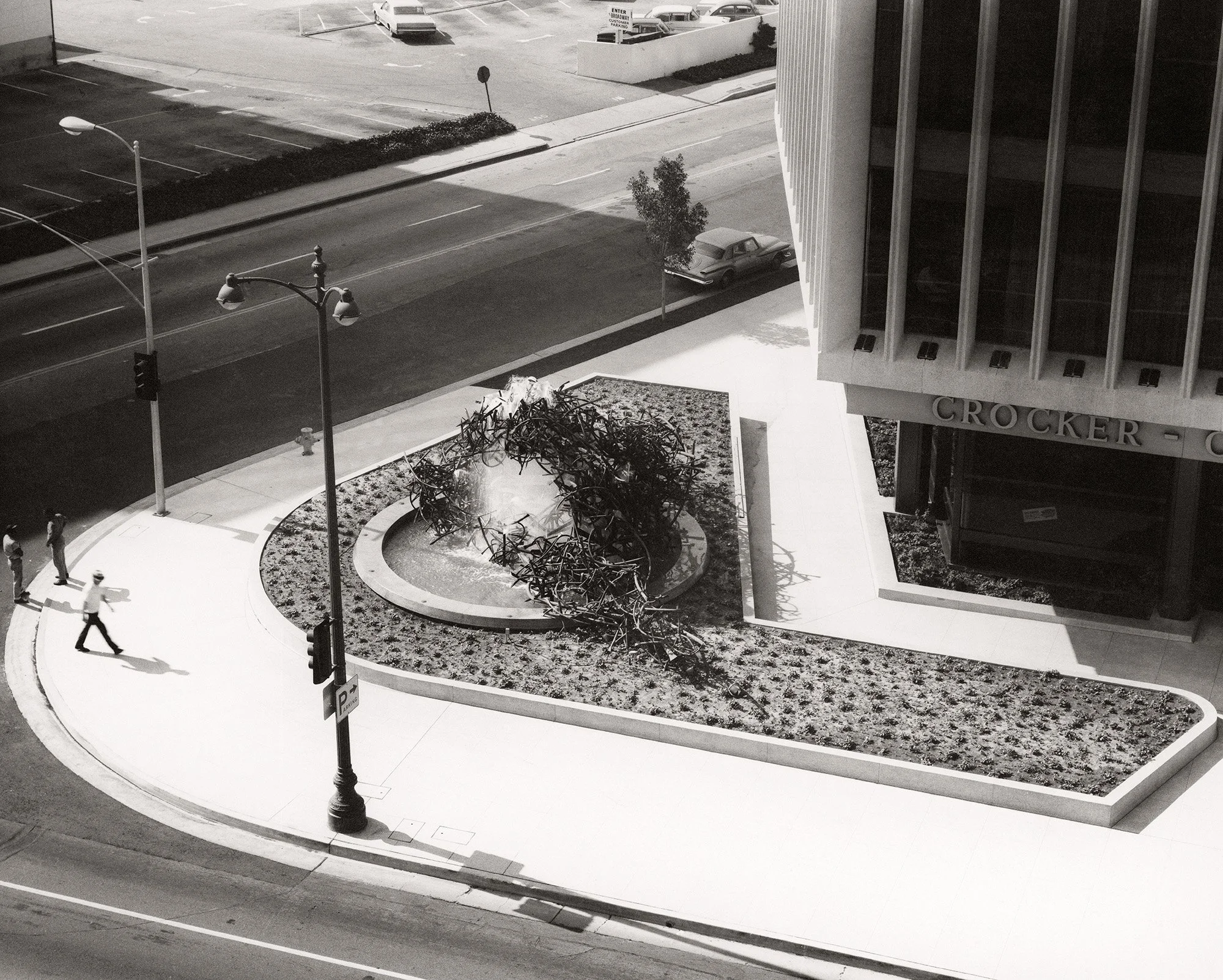
Claire Falkenstein's Structure and Flow #2 as seen from above, California Federal Savings & Loan Association Building, Los Angeles, California, 1965
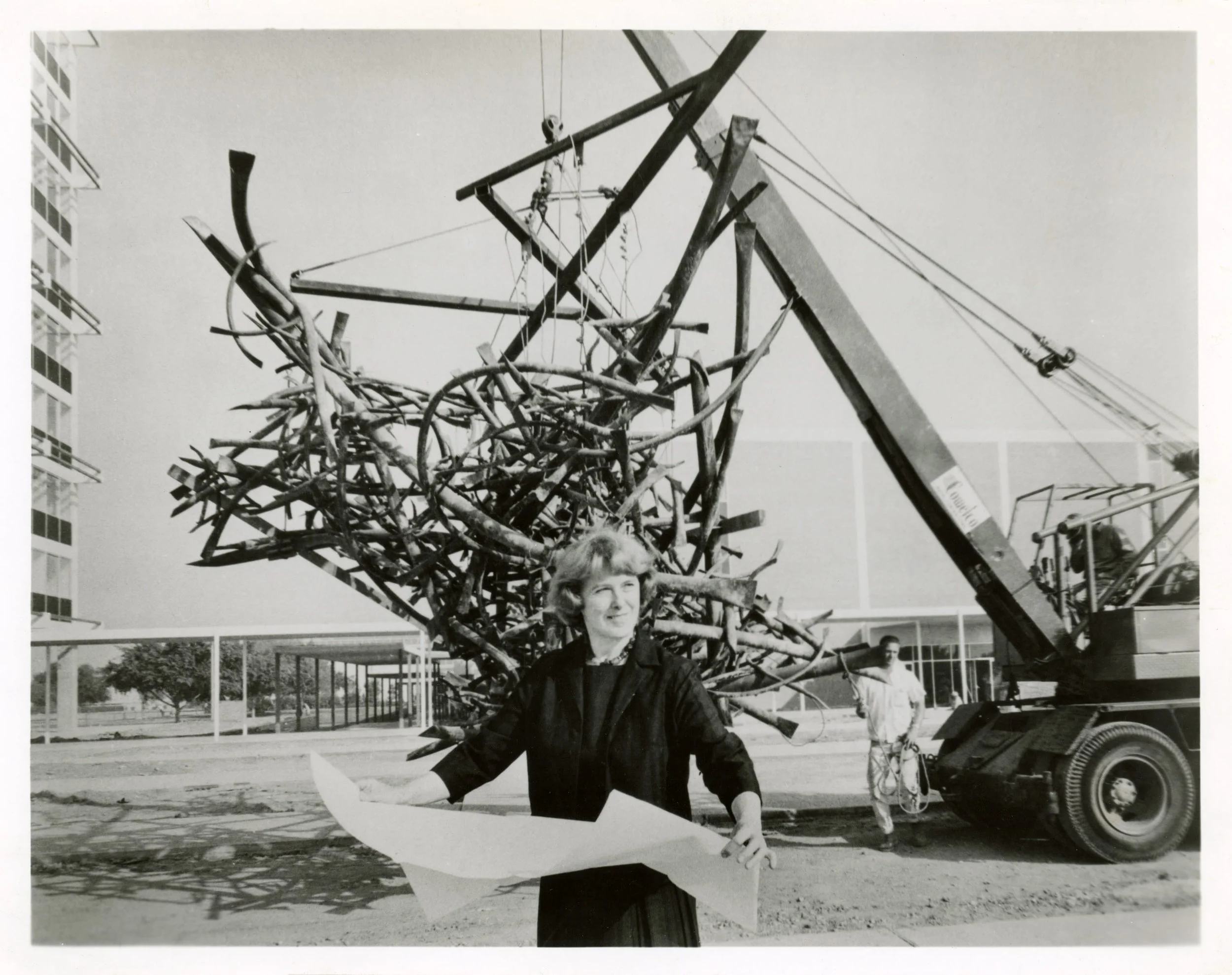
Claire Falkenstein during the installation of "U" as a Set on the campus of California State University, Long Beach, 1965. Photo from the collection of Lani Martin
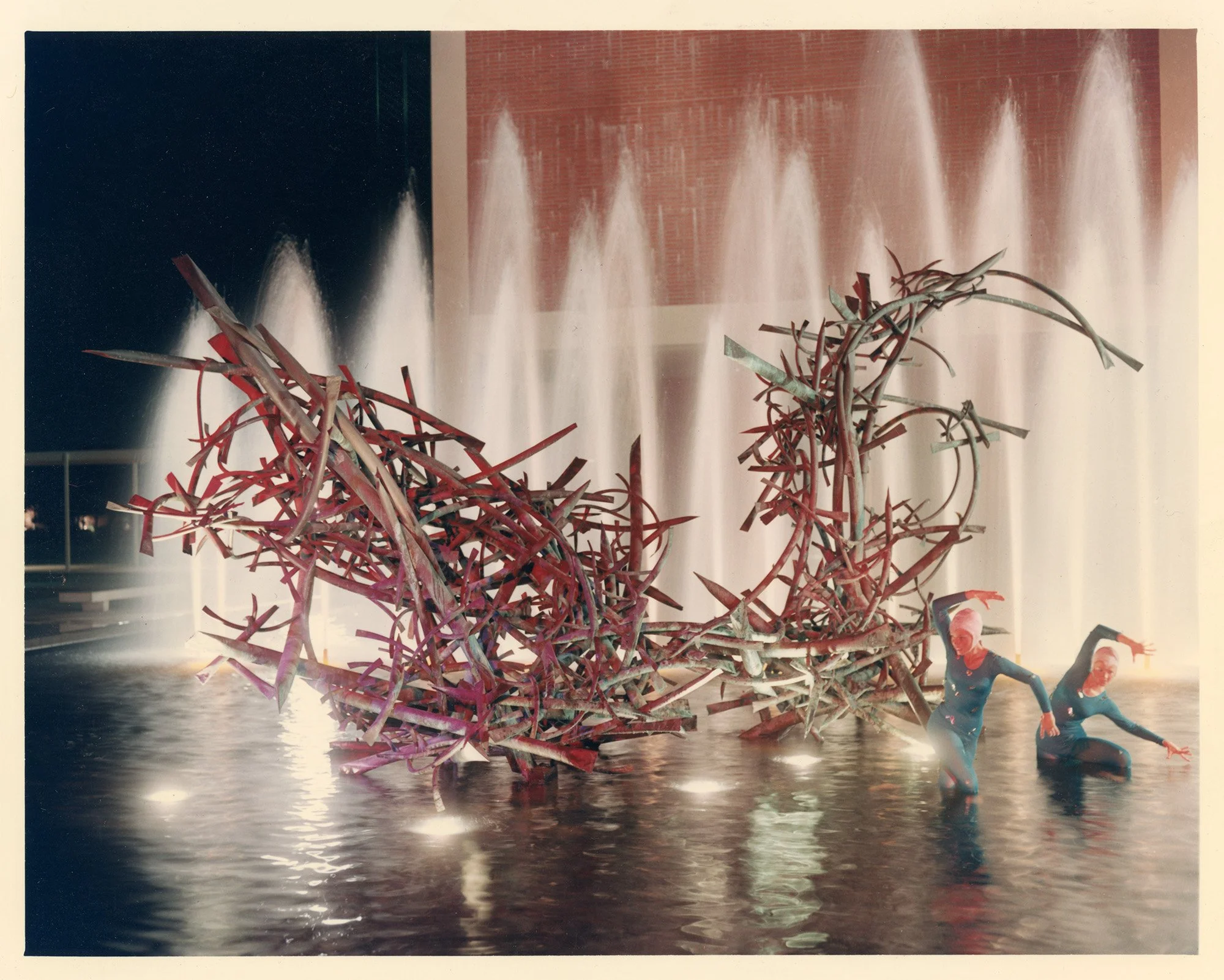
Claire Falkenstein's "U" as a Set with an aquatic performance, California State University, Long Beach, 1965
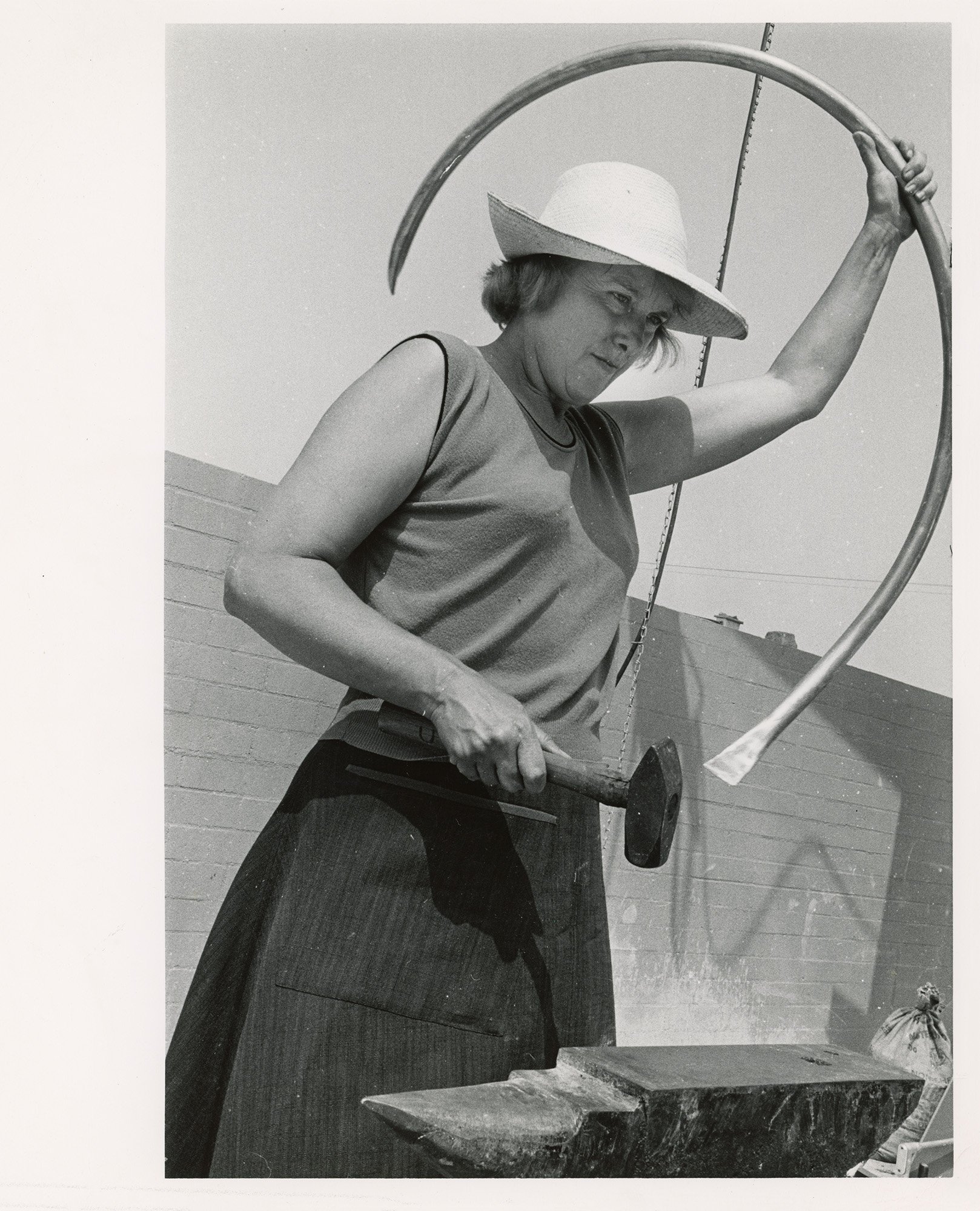
Claire Falkenstein working on a sculpture, Venice, California, c. 1960s. Photo from the collection of Lani Martin
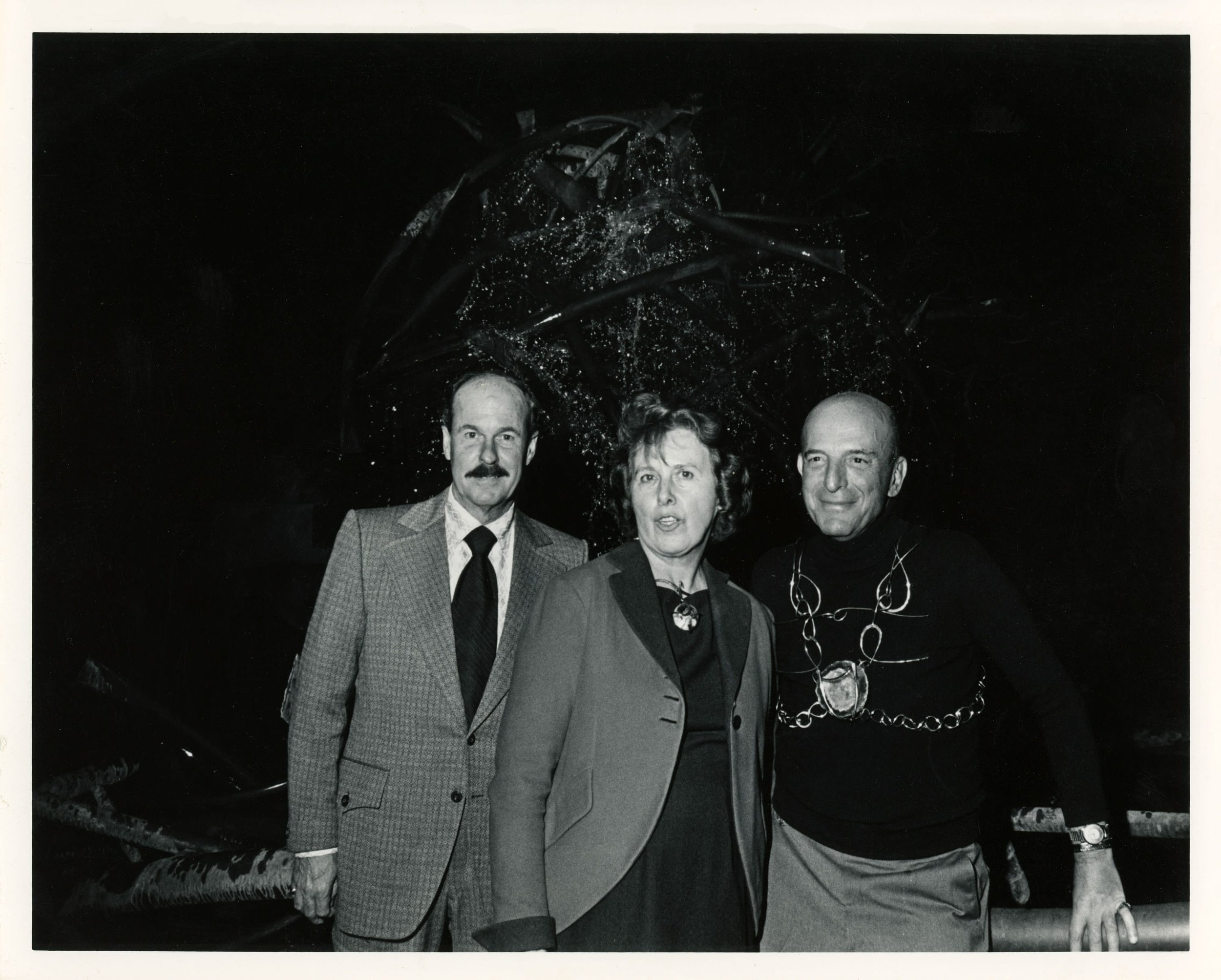
Claire Falkenstein with Louis Heyn (right, shown wearing Falkenstein's Body Chain) at the dedication of Structure and Flow #3 (1969) at the Long Beach Museum of Art, California, 1972
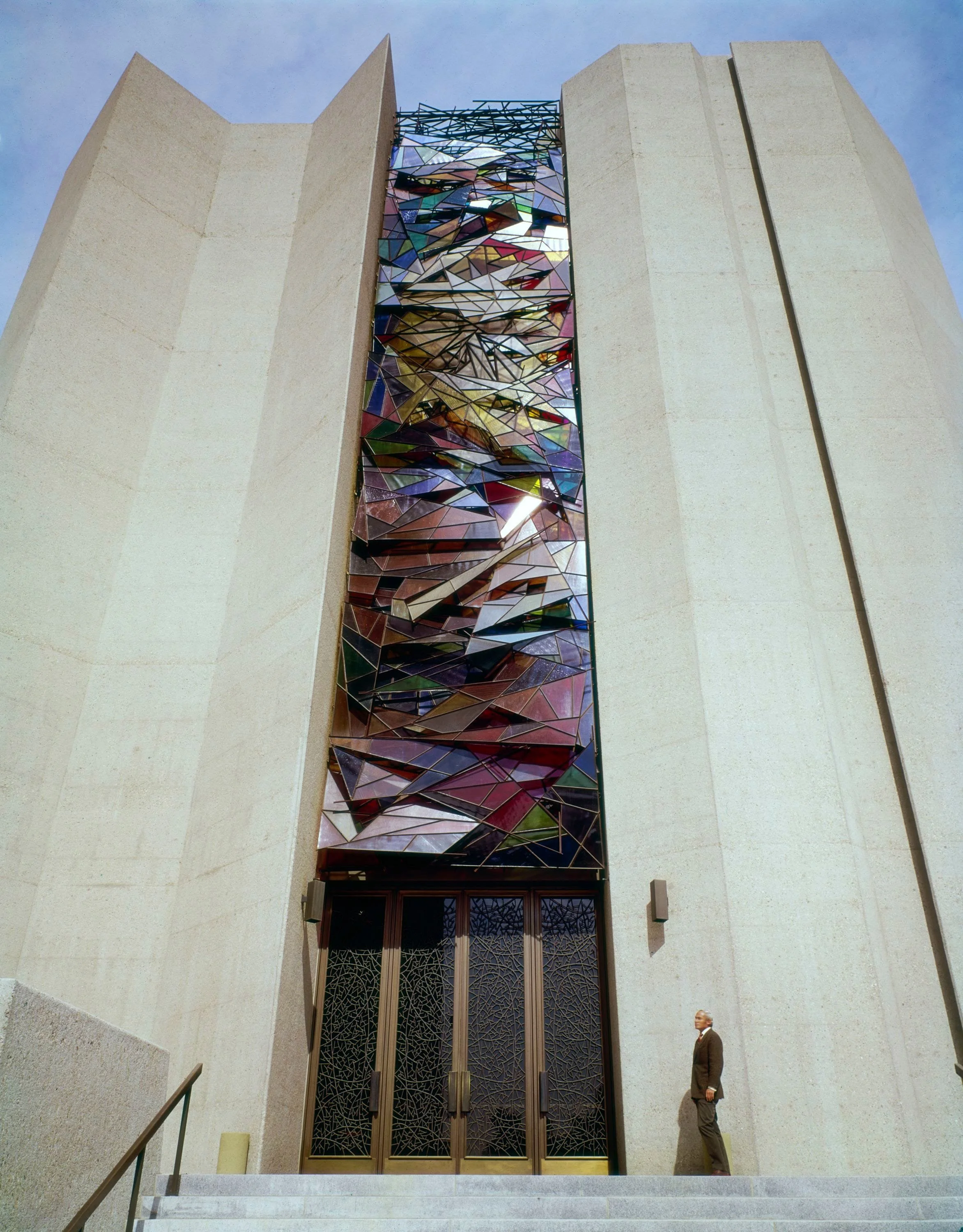
Julius Shulman, Exterior of St. Basil Catholic Church featuring Claire Falkenstein's stained-glass windows and doors, Los Angeles, California, 1969. © J. Paul Getty Trust. Getty Research Institute, Los Angeles (2004.R.10)
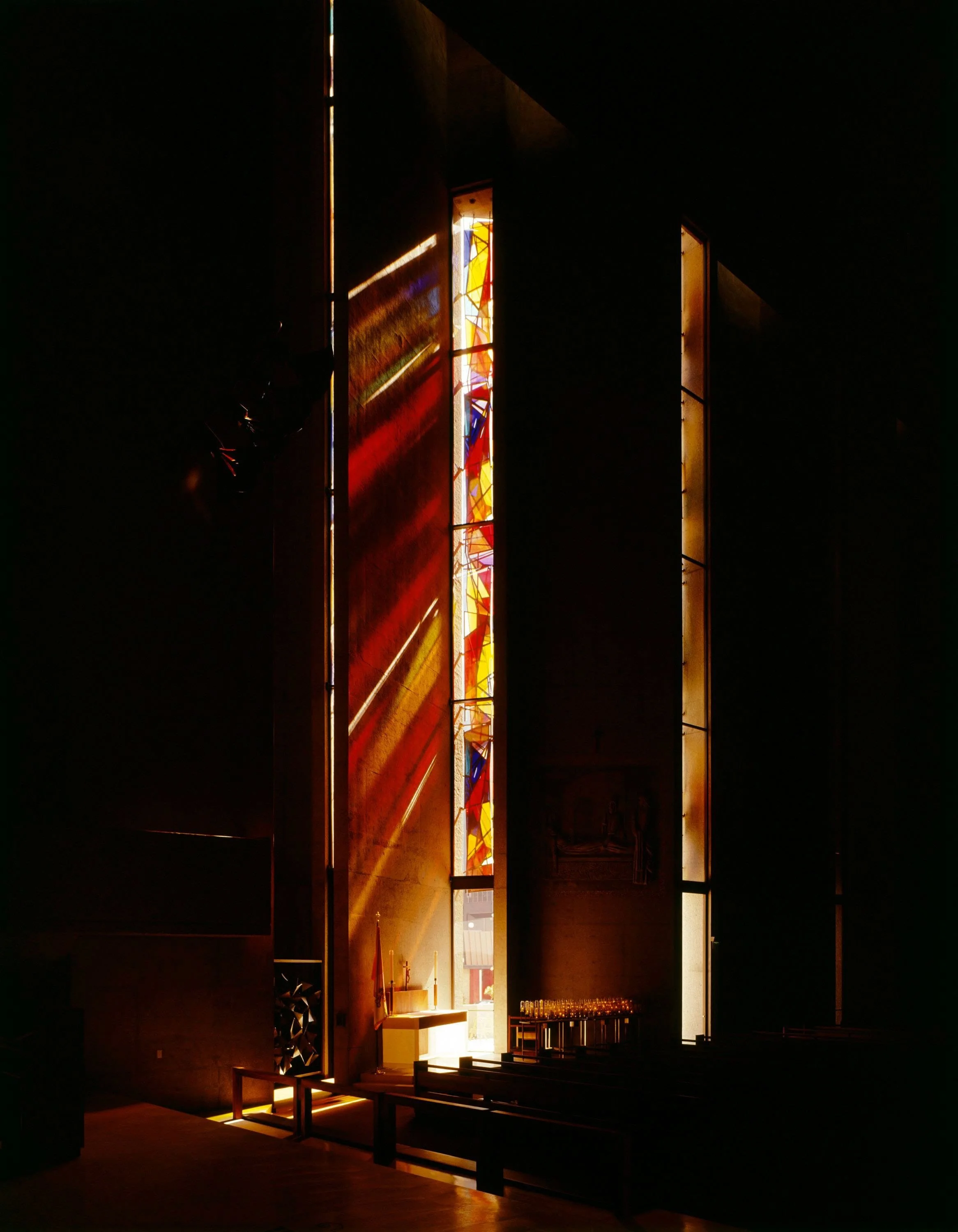
Julius Shulman, Interior of St. Basil Catholic Church featuring Claire Falkenstein's stained-glass windows, Los Angeles, California, 1969. © J. Paul Getty Trust. Getty Research Institute, Los Angeles (2004.R.10)
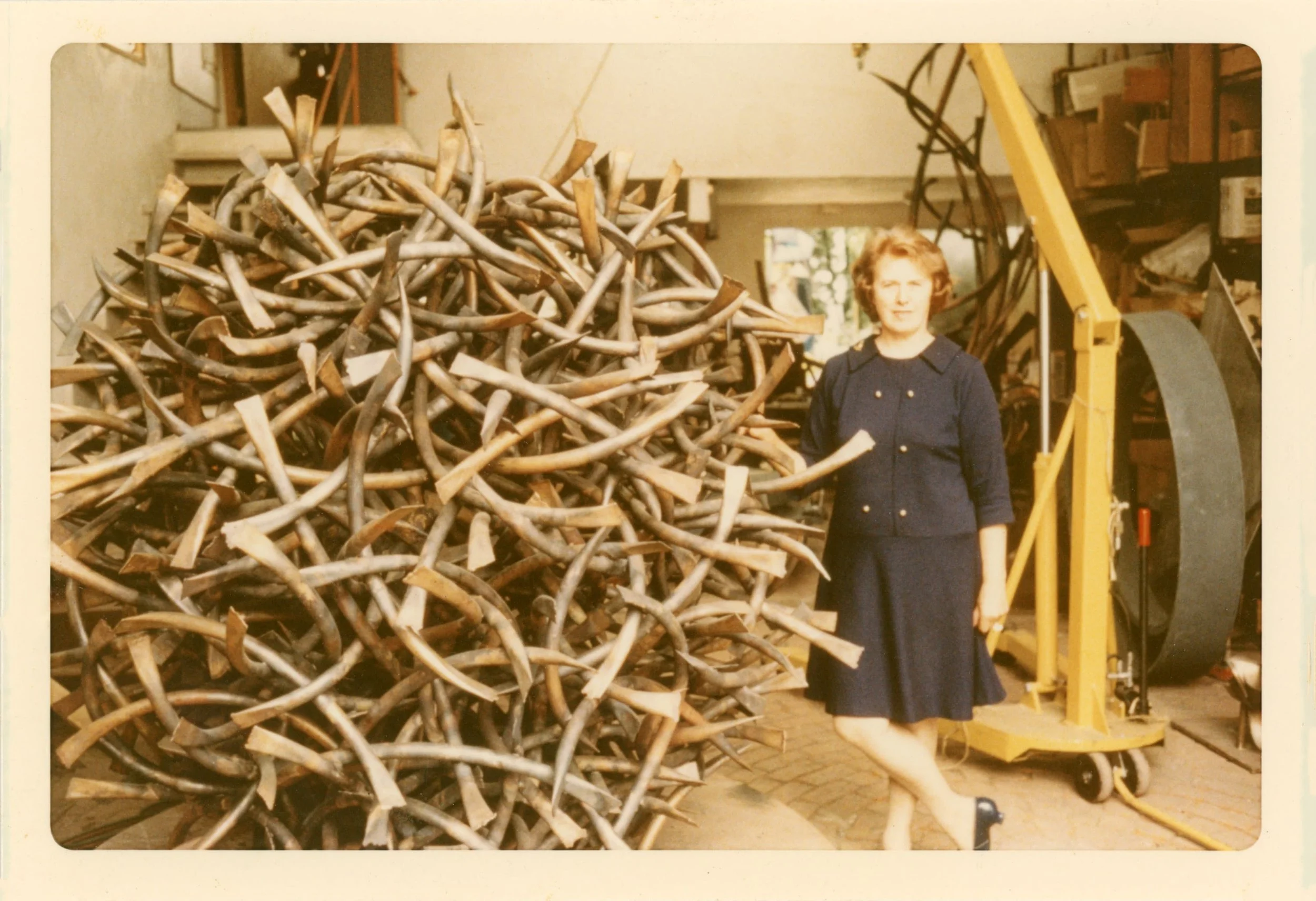
Claire Falkenstein with Point as a Set #25 in her studio in Venice, California, 1970
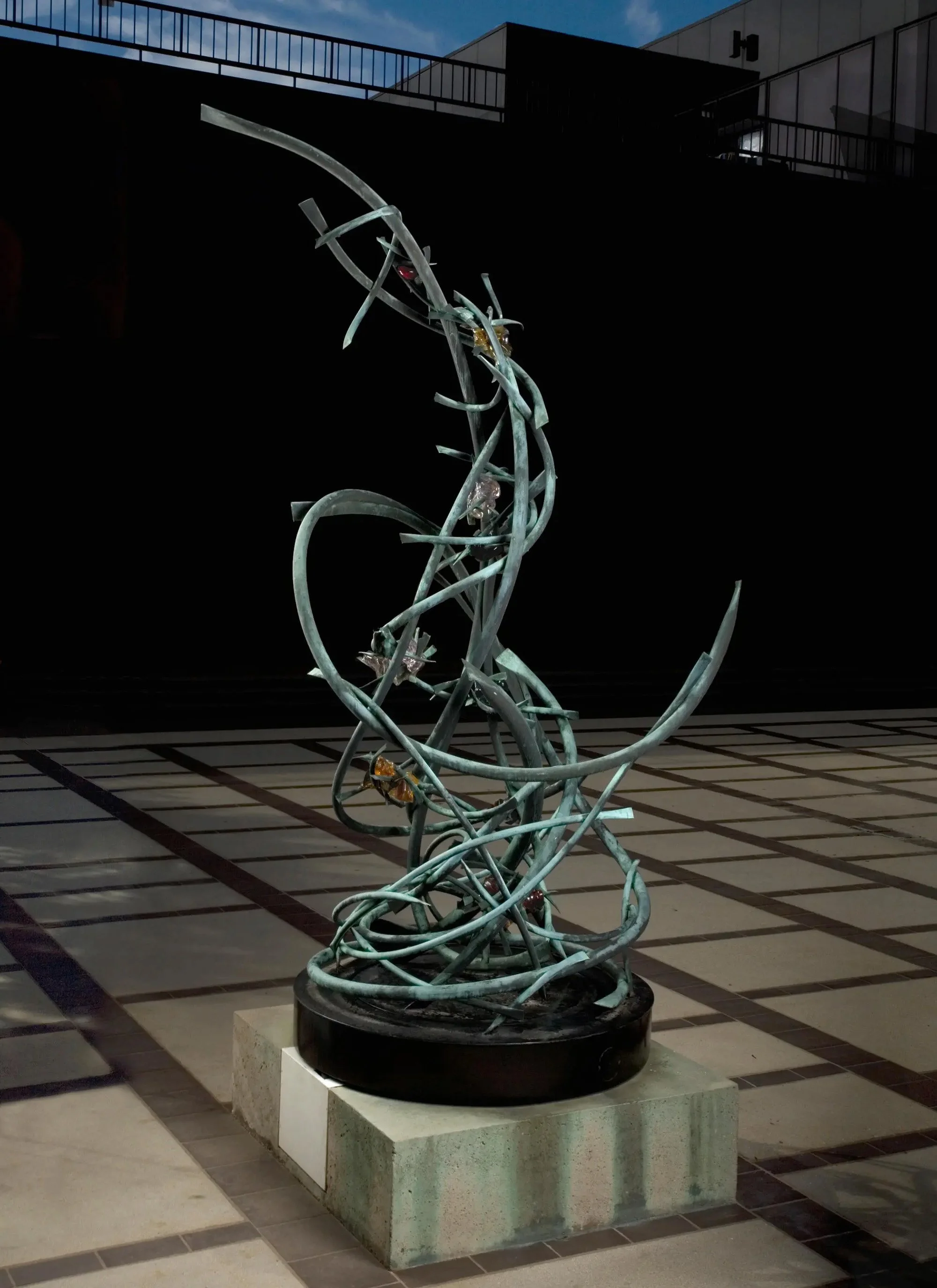
Claire Falkenstein's DNA Molecule at the Hyland Laboratories, Costa Mesa, California, 1970–71
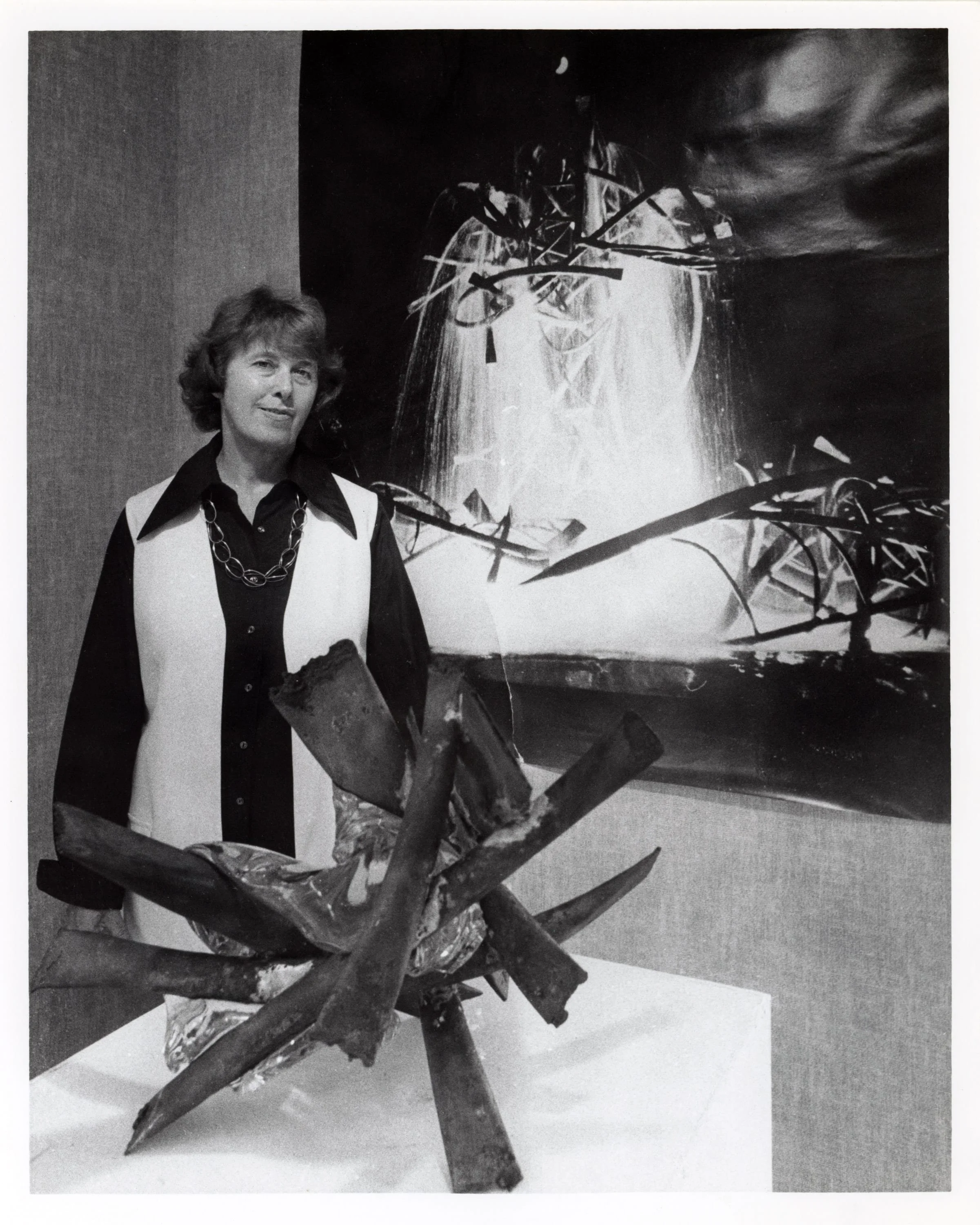
Claire Falkenstein at the exhibition Claire Falkenstein: Measurable Only in Probabilities, Arts Council Cultural Center, Thousand Oaks, California, 1975. Photo from the collection of Lani Martin
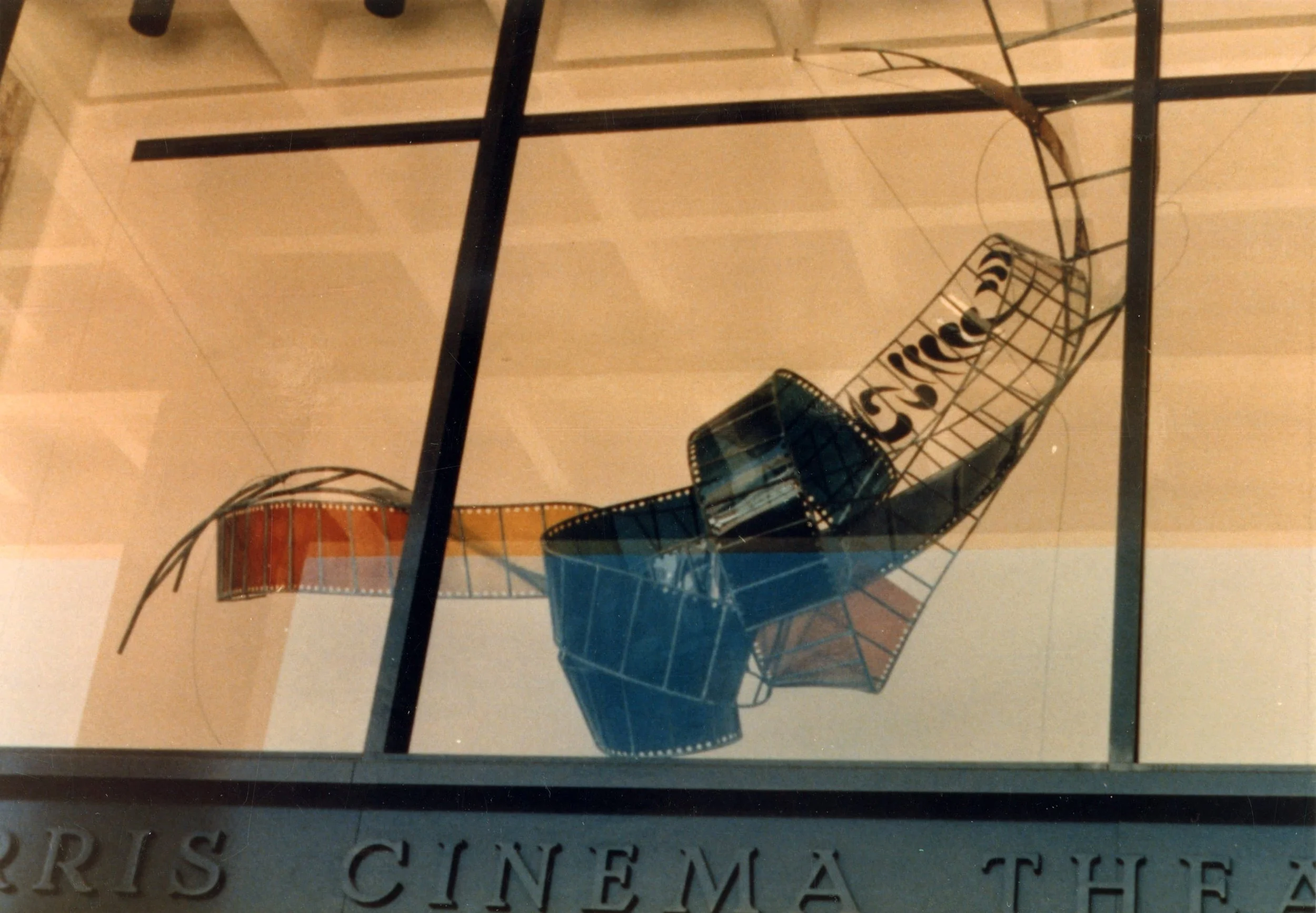
Claire Falkenstein's Montage/Section at the Eileen Norris Cinema Theatre, University of Southern California, Los Angeles, 1976
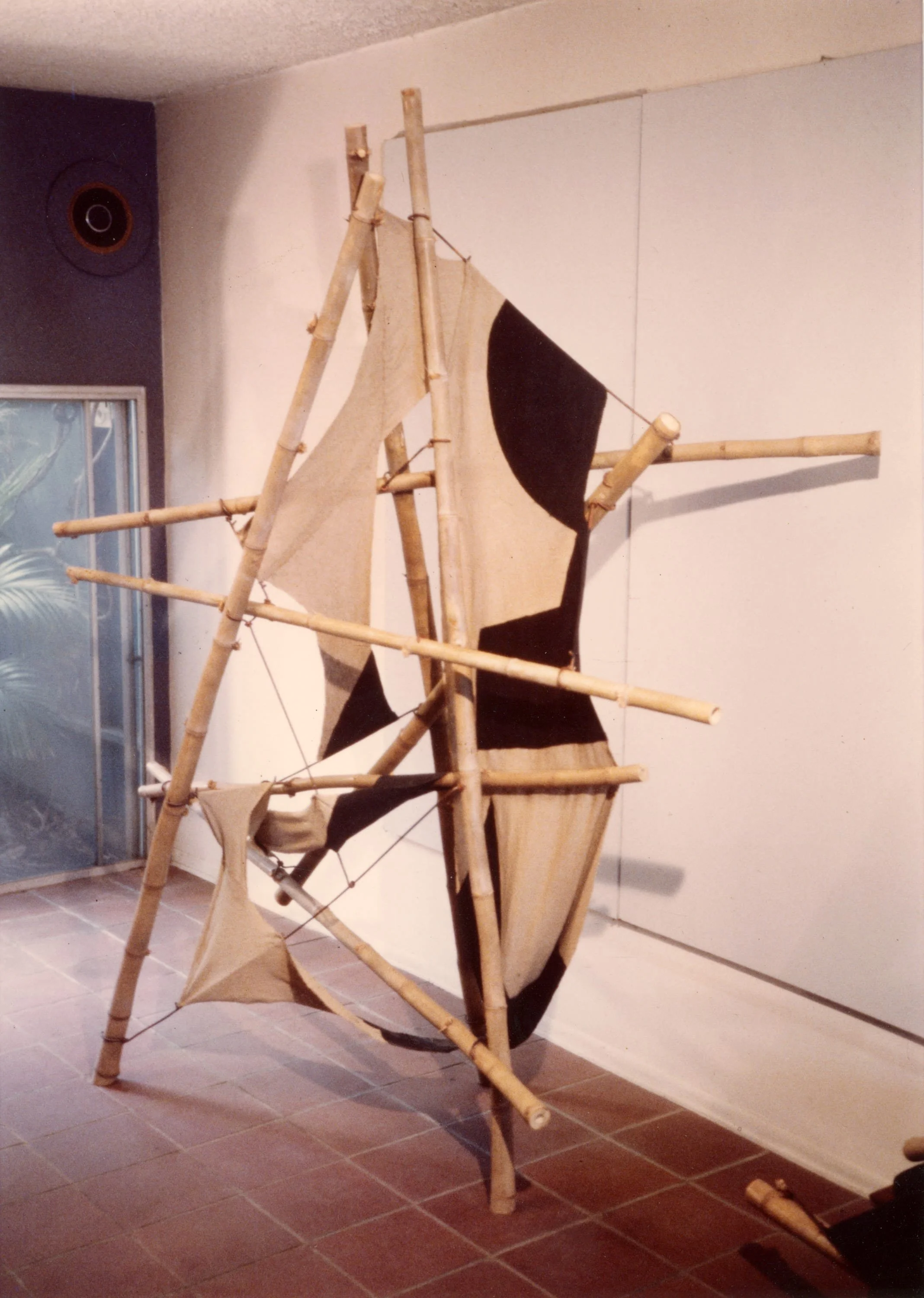
Claire Falkenstein, Emblem I, 1978
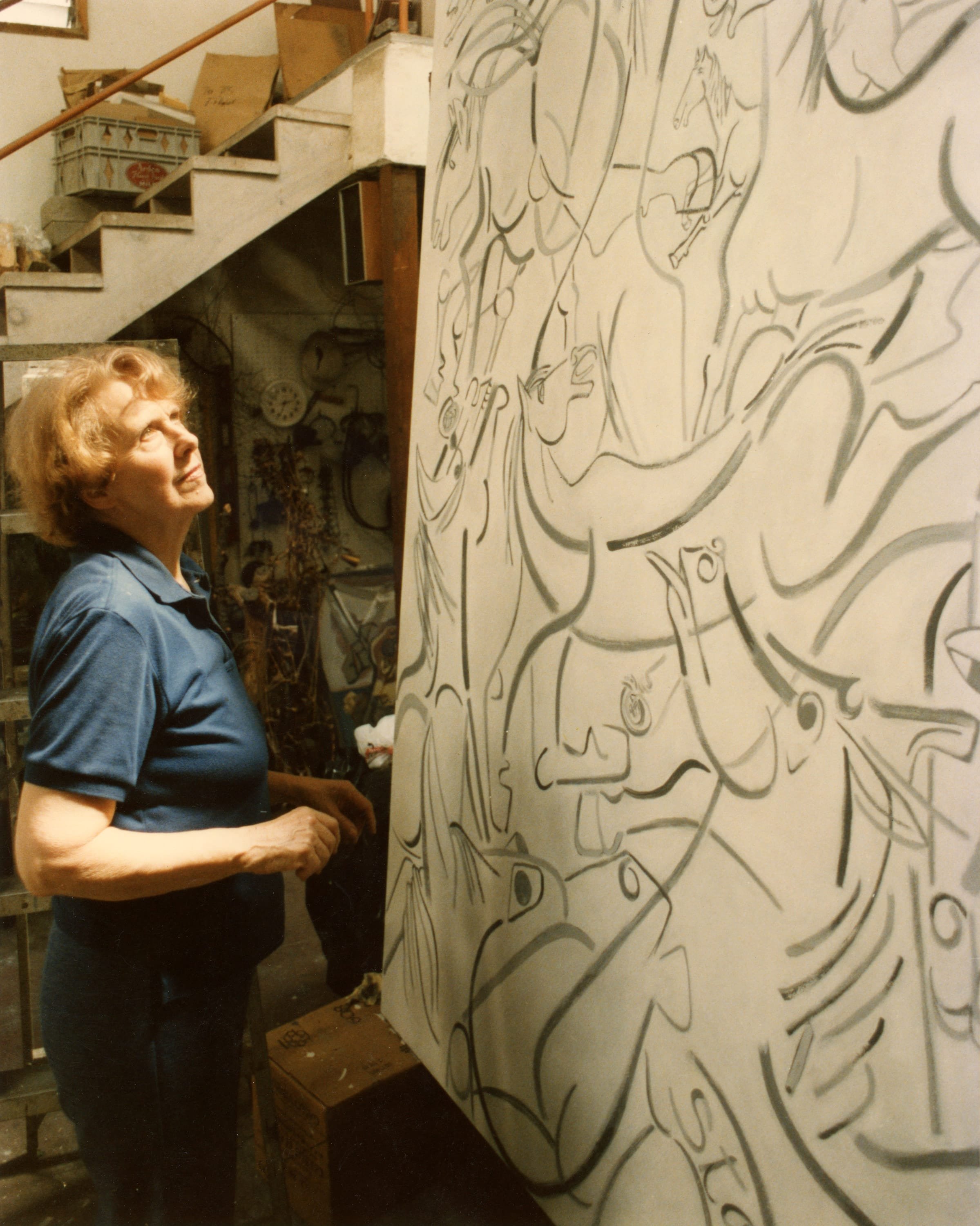
Claire Falkenstein with Stampede in her studio in Venice, California, 1987. Photo by Gordon B. Elkins. Photo from the collection of Lani Martin
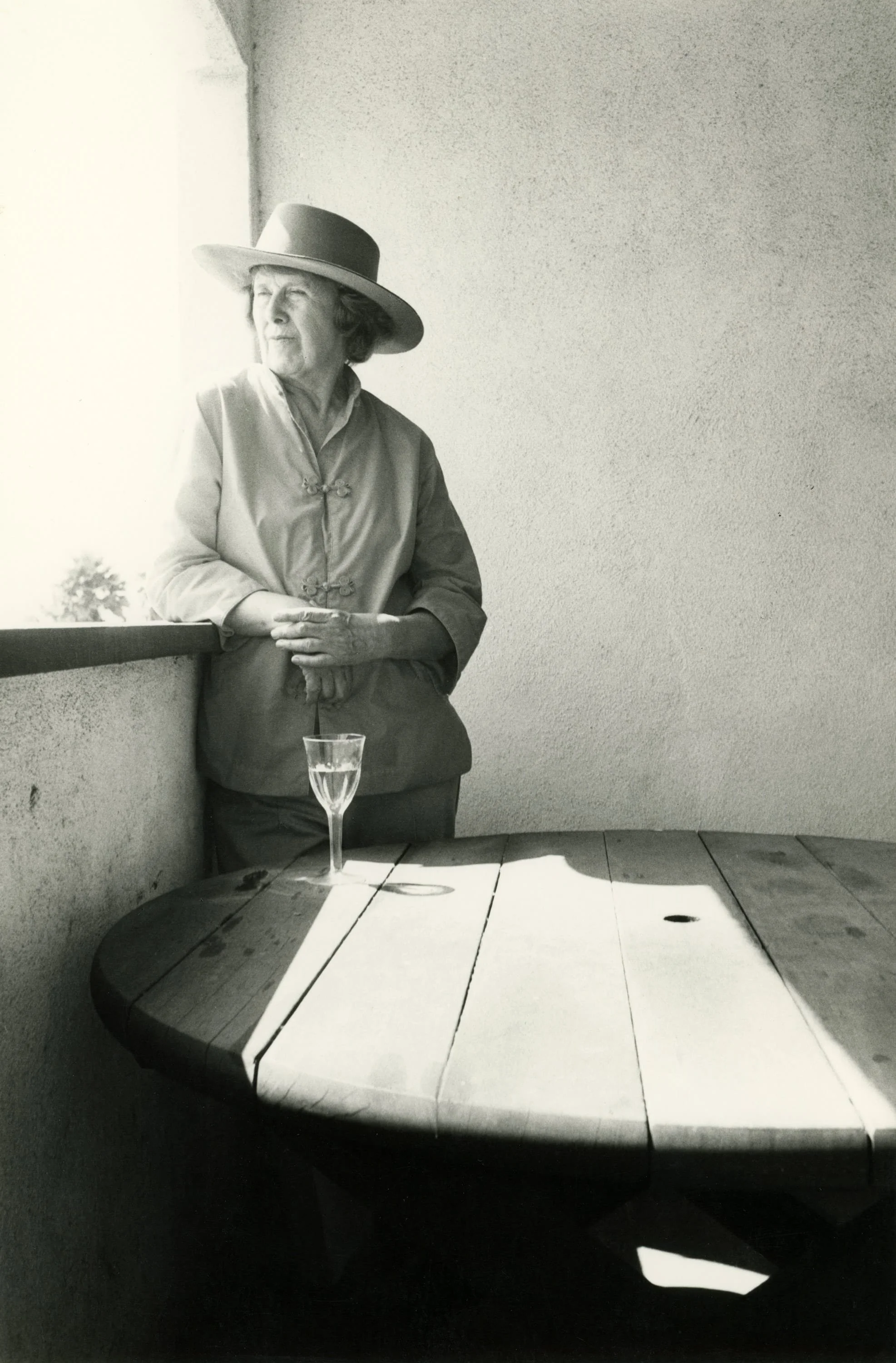
Claire Falkenstein at her home in Venice, California, 1982